Catalog note: Album entries can change. Use the live album link and WhatsApp to confirm the current option before ordering.
Hermès sizes silk by format, not by style: a scarf 45 measures 45 × 45 cm, a scarf 70 and a scarf 80 are the neck squares, a carré 90 is the large square most buyers picture, a scarf 100 is larger again, a shawl 140 is the giant cashmere-and-silk format, and a Twilly is a ribbon at 5 × 86.5 cm. The number in the name is a format code rather than an exact measurement, and the house's own pages prove it: the 90 is printed as 88.5 × 88.5 cm on the European, Middle Eastern and Macau stores, while the United States store prints the same product as 34.8 × 34.8 in, which is 88.4 cm. Every dimension carries one disclaimer — as this scarf is hand-rolled, the dimensions indicated may vary.
Hermès names its silk by size rather than by style: a Twilly is 5 cm wide and 86.5 cm long, the carré 90 is the format most buyers picture when they say a Hermès scarf, and the 140 shawl is the one that sits over a coat. Those numbers are format codes, not measurements, and the house’s own pages do not print them identically in every country.
The ladder runs from 45 cm to 140 cm in steps the house sells as separate products rather than one scarf in seven sizes. A scarf 45 is a pocket square by another name, a scarf 70 and a scarf 80 are neck sizes, a carré 90 and a scarf 100 are the large squares, and a shawl 140 is the giant format in cashmere and silk. The Twilly sits outside the ladder because it is a rectangle, not a square: 5 cm by 86.5 cm, sold as a ribbon to tie rather than a cloth to drape. Every one of those figures appears on the product pages themselves, and the pages carry versions of each in two unit systems, centimetres on the European, Middle Eastern and Asian stores and inches on the United States store. Comparing the two versions is the fastest way to see which numbers are names and which are measurements.
Nominal is the useful word. The house attaches one sentence to every dimension it prints: as this scarf is hand-rolled, the dimensions indicated may vary. That disclaimer explains why two pages describing one scarf can sit several centimetres apart, and why a scarf cut, rolled and hemmed by hand is never quite the format code it is sold under.
The formats Hermès sells, and what each number names
The house does not publish a scarf size chart the way it publishes a belt size chart. What it publishes is a name on every product and a filter on every category, and both use the centimetre figure, which is why collectors end up speaking in numbers instead of letters.
| Format as sold | Nominal size | What the house calls it | Typical construction |
|---|---|---|---|
| Scarf 45 | 45 × 45 cm | small-sized scarf; collectors say gavroche or pocket square | silk twill, hand-rolled edges; also made in cashmere and silk |
| Bandana 55 | 55 × 55 cm | bandana 55; sold in its own bandana filter | silk twill, hand-rolled edges |
| Scarf 65 | 65 × 65 cm | bandana scarf 65, fringed scarf 65 | silk twill, some lines hand-fringed |
| Scarf 70 | 70 × 70 cm | this 70 scarf format, light and easy to wear | silk, including vintage silk and washed silk |
| Scarf 80 | 80 × 80 cm | scarf 80 | silk twill |
| Carré 90 | 90 × 90 cm | the 90 scarf | silk twill, hand-rolled edges |
| Scarf 100 | 100 × 100 cm | scarf 100 | silk twill |
| Shawl 140 | 140 × 140 cm | shawl 140, a giant scarf | cashmere and silk, most often 70% / 30% |
| Twilly | 5 × 86.5 cm | Twilly silk ribbon | 100% silk, double-sided |
| Maxi Twilly | 20 × 220 cm | maxi twilly | silk twill |
Two of those formats are on the men’s line-up as well as the women’s. The men’s scarves and stoles category carries a bandana scarf 65 and a fringed scarf 65 alongside stoles, so the 65 is not simply a women’s format with a fringe added; the fringe belongs to a specific product, and the size code stays the same.
Where the house’s own two versions of one scarf pull apart
Hermès keeps regional storefronts that share product references, which makes the house its own second source. Opening one reference on two storefronts usually produces two dimension lines for one piece of cloth, and those lines only sometimes agree. The scarf 45 is the clearest case: the United States pages print 16.5 in by 16.9 in, a rectangle, against 45 × 45 cm on the British, Dutch, Belgian, Singaporean and Canadian stores. The shawl 140 is the widest gap: 53.5 in by 53.1 in on the United States pages against 140 × 140 cm elsewhere. The carré 90 is the case where the two versions quietly agree and both sit below the name.
| Format | United States page | Same product, another Hermès store | Do the two reconcile |
|---|---|---|---|
| Scarf 45 | 16.5 in × 16.9 in (41.9 × 42.9 cm) | 45 × 45 cm | No, and the United States pair is not even square |
| Carré 90 | 34.8 in × 34.8 in (88.4 cm) | 88.5 × 88.5 cm | Yes, and both are below the 90 in the name |
| Shawl 140 | 53.5 in × 53.1 in (135.9 × 134.9 cm) | 140 × 140 cm | No, roughly 5 cm per side |
| Twilly | 2 in × 34.1 in (5.1 × 86.6 cm) | 5 × 86.5 cm | Yes, to a millimetre |
Three further formats are only checkable on one side of that comparison. The scarf 80 is printed at 31.5 in by 31.5 in on the United States store, and 31.5 in is 80.0 cm, the one square in the ladder where the inch figure matches the centimetre name exactly. The scarf 100 is printed at 39 in by 39 in, which is 99.1 cm, so the round number in the name is a shade longer than the printed figure. The scarf 65 and the bandana 55 are printed as 65 × 65 cm and 55 × 55 cm on the Gulf and Greek storefronts, with no separate inch line to compare against.
What this does not mean is that one storefront is right and another is wrong. Both versions sit on product pages that carry the same hand-rolled disclaimer, and auction catalogues describe carré 90 lots as 90 × 90 cm or 35.4 × 35.4 in, which is the name used as a measurement. When the format code, the centimetre line, the inch line and the auction tape all describe one scarf, the sensible reading is a cloth of roughly 88 to 90 cm with a tolerance the house does not narrow.
The 90 in detail, and why it is the one people mean
Ask for a Hermès scarf without a number and you will be handed a carré 90, because it is the format with the deepest design library and the one the house itself calls iconic. It is large enough to be worn as a headscarf, folded into a triangle and knotted at the throat, or draped over the shoulders as a small wrap, and it is the size that made the genre: the house printed its first silk scarf in 1937 and the original carré measured 90 by 90 cm, a format it has never abandoned. The design library behind it numbers more than 2,500 original designs since that first scarf, with about a dozen new designs released each season, so a buyer choosing a 90 is choosing from the widest catalogue in the house.
The construction is where the 1.5 cm goes. A carré 90 is printed on silk twill woven in Lyon at roughly 65 grams per square metre, then cut and hand-rolled at the edge, and the roll consumes fabric: a flat-printed square of 90 cm becomes a finished scarf that measures about 88.5 cm once both hems are turned and stitched. That is exactly the figure the non-United-States storefronts print, and it is why the United States pages print 34.8 in rather than the 35.4 in that a straight conversion of 90 cm would give.

The 45 and the 65: the small squares, and the ones sold as crops
The 45 is the format most often bought without knowing its name. Collectors call it a gavroche, a pochette or a pocket square; the house now sells it as a scarf 45 and describes it in the same words on nearly every reference, as a small-sized scarf that works in your hair, around your neck or on a bag. It is the format with the most second lives, because the same design that sells as a 90 is often reissued at 45 as a detail version, showing a corner of the larger artwork rather than the whole scene, and collectors warn that a 45 can arrive without the design title or the artist signature that a 90 prints along its border.
The 45 is also the one format sold in two materials at the same size. Most references are pure silk twill with hand-rolled edges, while the Grand Tralala scarf 45 is made in cashmere and silk at 70% cashmere and 30% silk, described by the house as a matte version of the small icon for everyday wear. Two scarves of the same size, then, can differ in weight, warmth and how they fall, and the format number says nothing about which one you are holding.
The 65 is the format that grew out of the bandana line, sold as a bandana scarf 65 or a fringed scarf 65 and printed at 65 × 65 cm. Its fringe is part of the product rather than the size, so a fringed 65 and a hand-rolled 65 carry the same format code and a different edge. On the menswear side of the site the 65 sits with the stoles, which is a reminder that the same square can be filed under two categories depending on who is expected to wear it.
The 70 and the 80: the two neck sizes
The 70 is the format most often reached for after the 90, and the house’s own words for it are unusually plain: this 70 scarf format is light and easy to wear. Retailers carrying the house’s copy print its measurement as 27.5 in by 27.5 in, which is 69.9 cm, and the 70 is therefore the one square in the ladder where the inch line and the centimetre name convert cleanly into each other. It is 20 cm shorter on each side than a 90, which changes what the cloth can do: a 70 knots tightly at the neck without the bulk of a 90, but it will not wrap the shoulders or carry a full-scene print at the same scale.
The 80 sits between the 70 and the 90 and is easy to overlook, because it appears on fewer designs. It is sold as a scarf 80 on the United States store at 31.5 in by 31.5 in, which is 80.0 cm, and it behaves like a large neck square rather than a small shawl. Buyers comparing a 70 and an 80 are comparing two neck sizes 10 cm apart, and the difference in use is small enough that the print usually decides the purchase rather than the size.
The bandana 55, the 100, and what each name changes
The bandana is a format name, not a size, and the house runs it at 55 cm, printed as 55 × 55 cm with hand-rolled edges and sold under its own bandana filter. The product copy for the format describes it as sitting in your hair, at your waist or around your neck, which is a wider set of uses than the square scarf copy describes, and the bandana is the format that can be tied at the waist without looking like a folded scarf. Bandanas have also been made at 140 cm in earlier programmes, listed by resellers at 55 in by 55 in, so the word bandana alone does not fix the size.
The 100 is the largest square the house sells short of the 140, printed at 39 in by 39 in on the United States store, which is 99.1 cm. It exists in a smaller set of designs than the 90 and it does what a 100 does best, which is cover: it reaches further across the shoulders than a 90 while still folding down to a neck scarf, and its extra 10 cm is worth having for anyone who wants the cloth to sit on the shoulders without a pin or a knot holding it there.
The 140 shawl: the format that fits over a coat
The 140 is the format where the material changes as well as the size. Shawl 140 is cashmere and silk, described on the product pages as 70% cashmere and 30% silk, with some lines at 65% and 35%, and the house’s own copy calls it a giant scarf that is supple, light and easy to wear and the ideal companion for wrapping up on cold days. It is the format that goes over a coat because a 90 does not: 140 cm on each side is wide enough to cover the shoulders and long enough to knot at the front, and the cashmere mix is what makes that weight bearable rather than heavy.
The 140 carries the largest published disagreement in the ladder. The United States pages print 53.5 in by 53.1 in, which is 135.9 cm by 134.9 cm, while the Polish, Canadian and Belgian pages for the shawl 140 print 140 × 140 cm. The difference is about 5 cm on each side, or a hand’s width across the middle of the cloth, and it is the same hand-rolled variation that produces the 88.5 cm figure for the 90, applied to a bigger square.
The Twilly is measured by length, not by width
A Twilly is a silk ribbon: 5 cm wide, 86.5 cm long, double-sided, printed on the United States store as 2 in by 34.1 in. Its numbers are written in the opposite order from the squares for a reason, because the width is the fixed part and the length is the piece you actually use. The house’s copy calls it a small silk accessory that can be tied infinite ways, which is the closest thing to a size recommendation that exists for the format, and the format itself has been part of the house long enough that the site marks its twentieth anniversary.
Length is also the figure that moves. Twilly lengths vary in the hand, as one long-running collector’s survey of the format noted while comparing two Twillies of the same design, and the official figures are approximate even on the house’s own pages. Variants sit outside the standard ribbon altogether: a Twilly Long at 6.5 cm by 160 cm, a Twilly with a lambskin yoke at 5 cm by 116 cm, and an embroidered Twilly at 2 in by 51.2 in, all sold under a name that contains the word Twilly without sharing its size.
How far 86.5 cm of Twilly goes on a bag handle
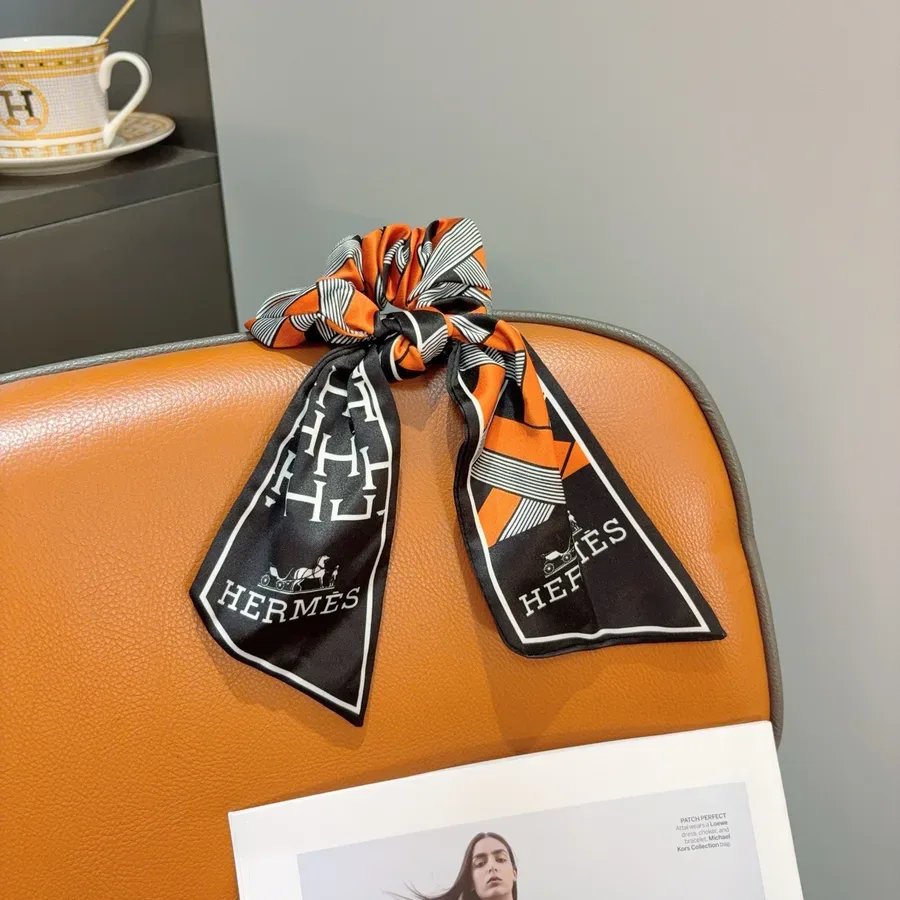
Twillys are bought for bag handles, and the arithmetic is worth doing before choosing a format. A single Twilly is 86.5 cm of ribbon, so it covers a handle that measures 30 cm around rather less than three times: two wraps take 60 cm and leave about 26 cm for the knot and the hanging tail, and three wraps take 90 cm and leave nothing. Which is to say a standard Twilly wraps a handle about twice. Where a handle is thicker, or the wrap is meant to cover the whole grip in leather, the format runs short and a different piece of silk is needed.
That is the practical reason a 45 square is not a substitute. Folded into a ribbon, a 45 gives about 45 cm of usable length, which is roughly one wrap, so a pocket square tied to a handle looks deliberate but covers very little. A 90 folded into a band gives a longer strip than a Twilly but a much thicker one, and the bulk changes how the handle feels and how the bag hangs on the arm.
The Maxi Twilly, and why resale measurements disagree
The Maxi Twilly is the long version of the ribbon, and it is the clearest illustration of how format codes drift. Listings on resale platforms describe the Maxi Twilly as 20 cm by 220 cm, and the format is widely known as the 220 cm Twilly. A Tokyo reseller measuring one Maxi Twilly listed under that same 220 cm name recorded 20 cm by 158 cm on the tape, which is 62 cm short of the code. Both figures describe the same format name, and neither is a claim about any other scarf.
Rectangle formats generally sit outside the square ladder, and the sizes in circulation show it: resale houses sort them into a 32 in by 2 in Twilly, a 70 in by 4 in Maxi Twilly and a muffler at 24.8 in by 70.9 in, alongside a small-group of squares at 7.87 in, 15.75 in, 27.5 in, 35.5 in and 55 in that map onto the 20 cm, 40 cm, 70 cm, 90 cm and 140 cm formats. When a scarf is described by name only, the name is a code rather than a tape measure, and the tape measure is the thing worth asking for.
What a photograph settles about a scarf, and what it cannot
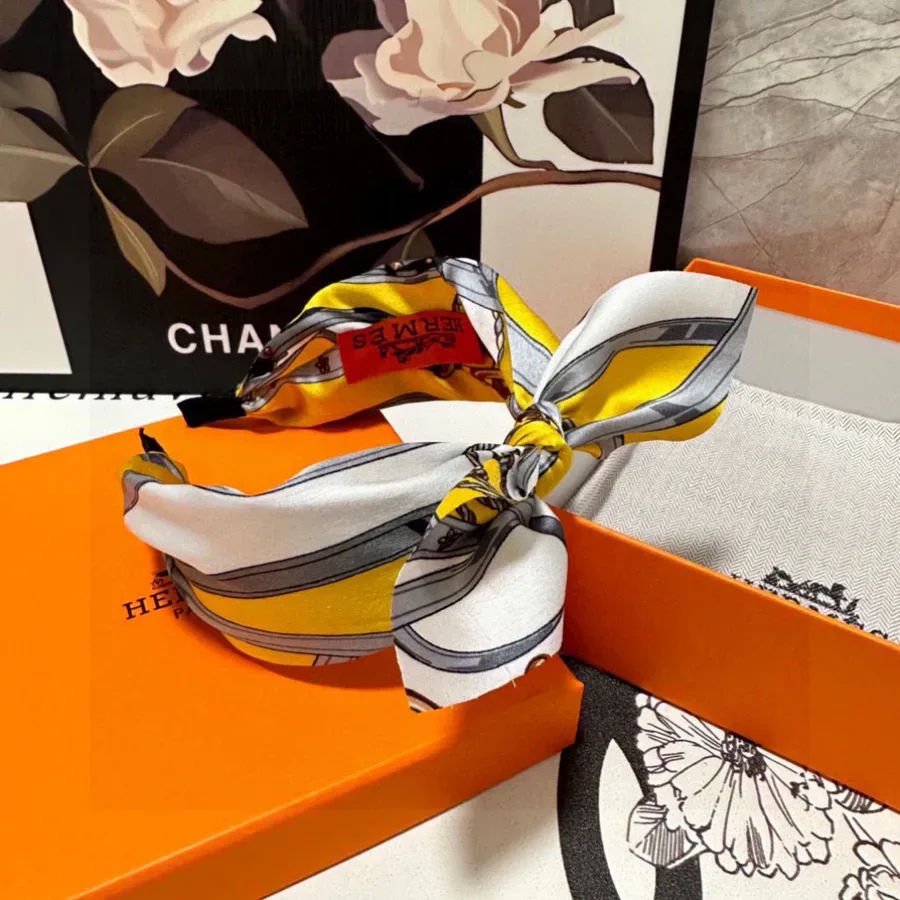
Scarf photographs are better evidence than most product categories for everything except size. They settle the print, the colourway, whether the hem is hand-rolled or fringed, whether the cloth is matte or lustrous, and whether the label and the design title are present at the edge. Those are the details that separate one reference from another of the same design, and they are what a buyer comparing a catalog screenshot against a product page is actually looking at.
They do not settle the format on their own. A 70 and a 90 photographed flat against different backgrounds are hard to tell apart without a reference object, and the same design is often printed in more than one format, so a photograph cannot say whether the cloth in the picture is the 70 version or the 90. A scarf photographed tied, worn, or knotted onto a bag hides the dimensions twice over, first because the cloth is folded and second because the useful length has gone into the knot. The number that answers a size question is a centimetre figure with a tape laid across the flat cloth, from edge to edge including the hem.
The five things to send when you ask about a scarf
A scarf question that resolves in one reply carries five things. The format number or the collector name, since a 45 and a 90 of one design are different purchases. The material, because cashmere and silk at 70% / 30% is a different cloth from pure silk twill at the same size. The flat measurement in centimetres across one side, taken with the scarf untied and the hem included. Whether the design title and the label are at the edge, which is where the small formats most often differ from the large ones. And the colourway number, because a design is printed in many colourways and two scarves of one reference can look nothing alike.
With those five, a size answer comes from a tape rather than a name code, and a scarf that is listed as a 90 can be confirmed as the 88.5 cm cloth that the storefronts print.
Browse the Accessories Catalog or send the format, the material and a flat measurement in centimetres on WhatsApp. The published figures quoted above are reference data collected for research in September 2026 and describe the formats as the house lists them, not any individual scarf. For the same question asked of a leather format, the Hermès belt size guide covers a category where the house does print a number; the Hermès sandal size guide shows how a house that publishes no chart leaves the tables to everyone else; the bag straps and handles guide sets out how a strap or handle is measured; and the accessory pairing guide covers how a scarf’s width should sit against a collar.
Where the figures in this page were checked
Every dimension above is attached to a page that prints it. The product and category pages were checked on 30 September 2026; colourways rotate, and a reference that has left the site may still leave its measurements and photographs in use elsewhere. Prices are deliberately not reproduced, because a format guide is not a price list.
| Source | What it establishes |
|---|---|
| Hermès: La Nature en Voyage scarf 90 | The United States dimension line for the 90, printed as 34.8 in × 34.8 in with the hand-rolled disclaimer |
| Hermès: La Nature en Voyage scarf 90 (Netherlands) and Hermès Parade scarf 90 (Canada) | The same 90 reference printed as 88.5 × 88.5 cm outside the United States |
| Hermès: Palonniers scarf 45 | The United States dimension line for the 45, printed as 16.5 in × 16.9 in |
| Hermès: Les Tigreaux scarf 45 (United Kingdom) | The same 45 format printed as 45 × 45 cm |
| Hermès: Grand Tralala scarf 45 | The 45 made in cashmere and silk at 70% / 30%, described as a matte version |
| Hermès: Palefroi shawl 140 and Cheval Masque shawl 140 | The United States dimension line for the 140, printed as 53.5 in × 53.1 in |
| Hermès: Mors a Jouets Chemise shawl 140 (Poland) and L’Epopee d’Hermes shawl 140 (Canada) | The 140 printed as 140 × 140 cm, the 70% / 30% composition, and the storage line |
| Hermès: Brides et Chaines scarf 100 and Ferronnerie Plein Soleil scarf 80 | The United States dimension lines for the 100 and the 80, printed as 39 in and 31.5 in |
| Hermès: Grand Tralala bandana 55 (UAE), Roaaaaar! Bandana scarf 65 (Greece), On Air! fringed scarf 65 (UAE) | The 55 and 65 dimension lines in centimetres, and the fringed variant of the 65 |
| Hermès: City of Light Twilly and Grand Apparat Twilly (Netherlands) | The Twilly printed as 2 in × 34.1 in in the United States and 5 × 86.5 cm in Europe |
| Hermès: silk scarves and accessories, women | The category taxonomy, whose filters are named carres 70 x 70, carres 90 x 90 and bandanas 55 x 55 |
| Hermès: men’s scarves and stoles | The 65 formats sold on the men’s line-up |
| JULL: complete guide to Hermès scarves | The 1937 first scarf and the original 90 × 90 cm carré, the design library count, the season cadence, the Lyon twill and the 65 g/m² figure |
| My Little Hermes Collection: 45 cm scarves | The collector names for the 45 and the observation that detail versions may omit the title and signature |
| Miss Bugis: Hermès square scarf size guide | The wider list of square formats, including 20 cm, 42 cm, 100 cm and round versions, and the material range |
| Madison Avenue Couture: Hermès scarves | The resale grouping of squares and rectangles, with the Twilly, Maxi Twilly and muffler figures |
| AuctionZip: designer scarf lot descriptions | The carré 90 measured at 90 × 90 cm and 35.4 × 35.4 in, and the carré 45 at 45 × 45 cm |
| PurseBlog: the Hermès Twilly | The observation that the official Twilly figures are approximate and that lengths vary between Twillies of one design |
| BagUSeek: Hermès Twilly guide | The Twilly variant formats, including the 6.5 × 160 cm long version and the 5 × 116 cm yoke version |
| 1stDibs: Maxi Twilly listings and GINZA XIAOMA: Maxi Twilly | The 20 × 220 cm Maxi Twilly figure and a tape measurement of 20 × 158 cm on a scarf sold under the 220 cm name |
| SpottedFashion: Hermès silk twill bandanas | The earlier bandana programmes at 55 and 140, with the second listed at 55 in × 55 in |
| Luxury Shops: silk Twilly listing | A second Twilly measurement, recorded as 5 cm by 86 cm |
Frequent questions about Hermès scarf sizes and formats
- What size is a Hermès scarf?
- There is no single size. Hermès sells a ladder of formats: scarf 45 at 45 × 45 cm, bandana 55 at 55 × 55 cm, scarf 65 at 65 × 65 cm, scarf 70 at 70 × 70 cm, scarf 80 at 80 × 80 cm, carré 90 at 90 × 90 cm and scarf 100 at 100 × 100 cm, plus the shawl 140 at 140 × 140 cm. The Twilly is the exception, because it is a rectangle: 5 cm wide by 86.5 cm long, sold as a ribbon rather than a square cloth.
- Is the Hermès carré 90 really 90 cm?
- Not to the centimetre. The 90 is the format name, and the house's own pages for the same product print 88.5 × 88.5 cm on the Canadian, Dutch, UAE and Macau stores and 34.8 × 34.8 in on the United States store, which converts to 88.4 cm. Resale listings and auction catalogues describe the carré 90 as 90 × 90 cm or 35.4 × 35.4 in, so the name and the measured cloth differ by roughly 1.5 cm on each side.
- How big is a Hermès Twilly?
- A standard Twilly is a silk ribbon measuring 5 cm by 86.5 cm, printed on the United States store as 2 in by 34.1 in. Length matters more than width here, because the ribbon is bought to wrap a bag handle, and the house's own copy calls it a silk ribbon to be tied infinite ways rather than a square to be draped.
- How big is the Hermès 140 shawl?
- The shawl called 140 is a 140 × 140 cm square in cashmere and silk, most often 70% cashmere and 30% silk, with some lines at 65% and 35%. The United States product pages for the same shawls print 53.5 in by 53.1 in, which is about 135.9 cm by 134.9 cm, so the largest format also carries the largest gap between its name and its printed measurement.
- What is a gavroche in Hermès sizing?
- Gavroche, pochette and pocket square are collector names for what the house itself now sells as a scarf 45, a 45 × 45 cm square printed on the European stores and as 16.5 in by 16.9 in on the United States store. The smaller formats are sometimes crops of a larger design, and collectors note that a 45 may arrive without the design title or the artist signature that a carré 90 prints at its edge.
- Which Hermès scarf format works on a bag handle?
- The Twilly, because it is 86.5 cm of narrow silk — long enough to wrap a handle and tie, where a 45 cm square is short and a 90 cm square is bulky. The same length is also the reason two Twillies of one design can measure differently when you lay them side by side, since the format is cut and rolled by hand.
- Why do two Hermès pages give different dimensions for one scarf?
- Because the house prints inches on the United States store and centimetres on the European, Middle Eastern and Asian stores, and the two versions are not always conversions of each other. For the 90 the two versions agree at about 88.5 cm; for the shawl 140 the United States page prints 53.5 in while the European pages print 140 cm; and for the scarf 45 the United States page prints 16.5 in by 16.9 in, a rectangle, against 45 × 45 cm elsewhere.