Catalog note: Album entries can change. Use the live album link and WhatsApp to confirm the current option before ordering.
Hermès sizes its sandals in French numbers with half steps — the Oran runs EU 34 to EU 42, the men's slides run EU 39 upward — and the house publishes no shoe size chart at all. Each Oran or Chypre page carries one fit sentence: choose your usual size, or size up a half size for a high instep. Because no chart comes from Hermès, the third-party tables disagree, and sharply: the same EU 37 is a US 7 on the Fashionphile chart, a US 7 on sizedepo and a US 6 on two other retail tables, with 23.5 cm to 24.0 cm attached to that one row. On the Oran the H cut-out is fixed, so a half size moves the strap across the instep as well as adding length; on the Chypre the strap adjusts. Measure the foot in centimetres, then apply the sentence.
Hermès sells the Oran sandal from EU 34 to EU 42 with half steps and its men’s slides from EU 39 up, yet the house publishes no shoe size chart: the only fit note on an Oran or Chypre page is one sentence asking for your usual size, or half a size up for a high instep. Every chart in circulation is a third party’s.
Two questions arrive under the same heading and need separating. The first is which number to order, and it has little to do with the label itself: the Oran follows French sizing, so the box reads 34 to 42 in half steps, and the trouble starts where that number is converted into US or UK. One published chart calls a French 37 a US 7, another calls a European 37 a US 6, and the centimetre column attached to each row gives 23.5 cm in one case and 24.0 cm in the other. The second question is what the number will feel like on the foot, which on a slide with a fixed H cut-out is decided at least as much by where the strap crosses the instep as by length. Hermès answers the first question on no page of its own, and the second in a single line repeated word for word across models and colourways.
The tables below are collected from the house itself and from four resale and retail sources, each with the date it was checked, so that the disagreement stays visible instead of being averaged away.
What Hermès itself publishes about sandal sizes
The size-guide page on the US site is worth reading precisely because of what is missing from it. It documents two product families: enamel bracelets, which come in 62 mm, 65 mm and 70 mm diameters with the Clic H in a small (6 cm) and a large (6.5 cm) version, and belts, which are sized in centimetres from the base of the tongue to the hole you use most. Shoes and sandals are not on it. No insole length, no foot length, no EU to US conversion is published there at all.
What exists instead is a sentence attached to each product. On the Oran in Box calfskin it reads: we recommend choosing your usual size, or sizing up a half size for a high instep. On the Oran in Epsom calfskin the same sentence appears, followed by a second line advising a size up if you are between sizes. On the Chypre in suede goatskin the first sentence is repeated again, unchanged. Three models, two materials, one instruction — and no number anywhere in it.
That is the reason this page exists. A buyer who wants to know whether to take a 37 or a 38.5 is not being asked to read a table badly; there is no table, from the house, to read. Every conversion in circulation was compiled by somebody else, which is also why they do not match.
Three sandals, three fits, one identical sentence
The Oran, the Chypre and the Izmir are often discussed as if they were the same shoe in three price brackets. They are three different constructions, and the sizing consequence differs with each.
The Oran is the flat one. Its product details list a leather sole, a leather edge and a lambskin insole and lining, with no buckle, no velcro and no adjustable element: the upper is one piece with the H cut out of it. Its heel is given as 0.4 inch with a 0.2 inch difference between the front sole and the heel, which makes it very nearly level. The model dates to 1997 and is credited on the house’s own page to Pierre Hardy, with the H cut as the element that carried it through every subsequent collection.
The Chypre is the technical one. The house describes it as a techno-sandal in suede goatskin on an anatomical rubber sole with an adjustable strap, and the sole height is quoted at 1.2 cm on the Chinese page and 0.5 inch on the US page of the same family. The strap that crosses the foot is adjustable, which the Oran’s is not.
The Izmir is the men’s dress version: calfskin with the H cut-out and contrasting sole sides, in the men’s line-up alongside the Chypre, Naxos, Kazimir, Jackson, Nikos, Miky and Motif slides and the Trip, Antigua and Nil espadrilles.
The Oran ladder, and the half step the house actually leans on
The Oran runs from EU 34 to EU 42 and includes half sizes across that range. The half step is not decoration: it is the exact movement the house’s own sentence asks for, which means a buyer told to size up half a size is being told to take 38.5 instead of 38, not to skip to 39. Sandals whose ladder offers no half step leave that instruction with nowhere to land.
Availability is a second filter. Colourways come and go faster than sizes do, and a size menu on a live product page is not a promise that the same step exists in the leather you have chosen. When a pair is being sourced remotely, the answer to “is there a 38.5” and the answer to “is there a 38.5 in this colour” are two different questions, and only the seller of the exact pair can answer the second one.
Where the published Oran charts disagree
Four tables for the same sandal, all reachable online, put the same French numbers against different American ones. Fashionphile’s chart for the Oran, printed and read on 29 September 2026, runs FR 34 to FR 42 with the US column one step behind the French number from 37 upward: FR 37 is US 7 and UK 4, FR 38 is US 8 and UK 5, FR 39 is US 9. Sizedepo’s Hermès women’s table prints the same mapping for 37 and 38. Choozeshoe’s Hermès women’s chart calls EU 37 a US 6, EU 38 a US 7 and EU 39 a US 8, and sizechartly’s Oran page prints those identical figures.
| FR (as printed) | Fashionphile chart | sizedepo | choozeshoe / sizechartly | baguseek |
|---|---|---|---|---|
| 36 | US 6 / UK 3 / JP 23 | US 6 | US 5 / 22.9 cm | US 6 / 23.0 cm |
| 37 | US 7 / UK 4 / JP 24 | US 7 | US 6 / 23.5 cm | US 7 / 24.0 cm |
| 38 | US 8 / UK 5 / JP 24.5 | US 8 | US 7 / 24.1 cm | US 8 / 24.5 cm |
| 39 | US 9 / UK 6 / JP 25.5 | US 9 | US 8 / 24.7 cm | US 9 / 25.0 cm |
| 40 | US 10 / UK 7 / JP 26.5 | US 10 | US 9 / 25.4 cm | US 10 / 25.7 cm |
| 41 | US 11 / UK 8 / JP 27 | US 11 | US 10 / 26.0 cm | US 10.5–11 / 26.3 cm |
Read the 39 row and the scale of the problem is clear: one table says a US 9, another says a US 8, and the centimetre figures sit at 24.7, 25.0 and 25.5 cm. That last spread is 0.8 cm, which is close to a full size on a shoe last. Two of the tables also disagree about what their own numbers mean: the Fashionphile chart carries a JP column that reads 24 cm at FR 37, which is a last or insole figure, while baguseek’s chart attaches 24.0 cm at the same row as a foot length and 24.5 cm at FR 38. They meet at 37 and part company above it.
For all that, the sources converge on the shape of the answer. Fashionphile’s own prose says the sandal follows French sizing and generally fits true to size, going up a half size for wider feet. Baguseek’s guide says the reverse only in tone, calling the Oran narrow with no width options, and advises half a size up for wide feet or a high instep. A UK sourcing page for the model puts a UK 4 at roughly EU 37, a UK 5 at EU 38 and a UK 6 at EU 39 — the same ladder as Fashionphile’s chart — and adds the useful warning that the leather softens but does not stretch in length. A resale listing on Rebag, not a chart at all, pairs a US women’s 9.5 with an IT 39.5, which agrees with the Fashionphile row where FR 39.5 is US 9.5.
Men’s Hermès slides run on a separate ladder
The men’s tables start where the women’s finish. Sizedepo’s Hermès men’s chart runs EU 39 to EU 46, mapping EU 39 to a US 6, EU 41 to a US 8, EU 43 to a US 10 and EU 46 to a US 13, with a millimetre column that reads 245 mm at 39 and 290 mm at 46. A retailer chart for the Chypre prints EU 41 as a US 9 and a 26.0 cm foot, which is a full American size above the sizedepo figure for the same European number — the same kind of one-step disagreement that the women’s charts show, only on the men’s scale.
The practical point for a man is which ladder he is reading. The Oran tops out at EU 42 in the women’s line-up, so the H-strap slide in men’s sizes is the Izmir, and the adjustable version is the men’s Chypre, which is listed up to EU 46 and above. A men’s EU 44 question aimed at the Oran’s table is aimed at the wrong ladder entirely.
Centimetres are the only figure that travels between charts
Because no two charts agree on the letters and numbers, the transferable figure is the foot length in centimetres, and even that needs care about what is being measured. The Fashionphile JP column and baguseek’s foot-length column agree at FR 37 (24 cm and 24.0 cm) but separate above it, and the two-column comparison in the table above shows the same pattern at 39: 25.5 cm against 25.0 cm.
The measurement itself is the part a buyer controls. Stand on paper with the heel against a wall, late in the day when the foot is at its largest, in the socks you mean to wear, and mark the longest toe; measure both feet and take the longer. Read that figure against the centimetre columns in the table above and, if it falls between two rows, take the larger row. Feet do not take a half size badly on a sandal the way they do inside a closed shoe: what has to be avoided is toe or heel hanging off the footbed, and what has to be checked separately is the strap position.
What changes the fit at the same number
The same French number feels different across the Oran and the Chypre, and it also feels different within one model. The upper materials set that difference. Box calfskin, Epsom calfskin, calfskin, suede goatskin and a shearling-lined version all appear in the Oran’s own material lists, and the sole and lining lines change with them: one reference lists a natural leather sole with a grezzo leather edge and a lambskin insole and lining, another a black leather sole with black lining, and the shearling version an Etoupe shearling insole over a black leather sole. A shearling insole occupies space inside the sandal that a plain lambskin one does not, which is the reason the same printed size can feel tighter in one material and roomier in another.
Leather behaviour points in the other direction, slowly. Resale guidance for the Oran says the leather relaxes and softens with wear and gains some room without stretching dramatically, while the UK sourcing note puts it more bluntly, that the leather softens but does not stretch in length. Both statements can be true at once: the strap and the edges give a little across the foot, and the length of the footbed does not grow. Practical consequence: if the foot overhangs in the shop or on the day the pair arrives, it will still overhang in August.
The strap is the third variable and the one most often overlooked. On the Oran there is nothing to adjust, so the half step does two things at once — it adds length and it shifts where the H crosses the instep. On the Chypre the strap absorbs part of that same variation, which is why the two models can carry an identical fit sentence and still need different buying decisions from a wide-footed or high-instepped buyer.
What an album photograph settles, and the two numbers it cannot
Photographs of the model, whether from a seller’s album or a resale listing, are excellent evidence for identity and poor evidence for size. What they do settle is the version: the H cut-out and one-piece upper identify the Oran, a strap across the foot over a thicker rubber sole identifies the Chypre, and a two-tone upper with contrasting sole sides on a men’s last points at the Izmir. The material is often readable too, from the nap of suede against the surface of calfskin or Epsom.
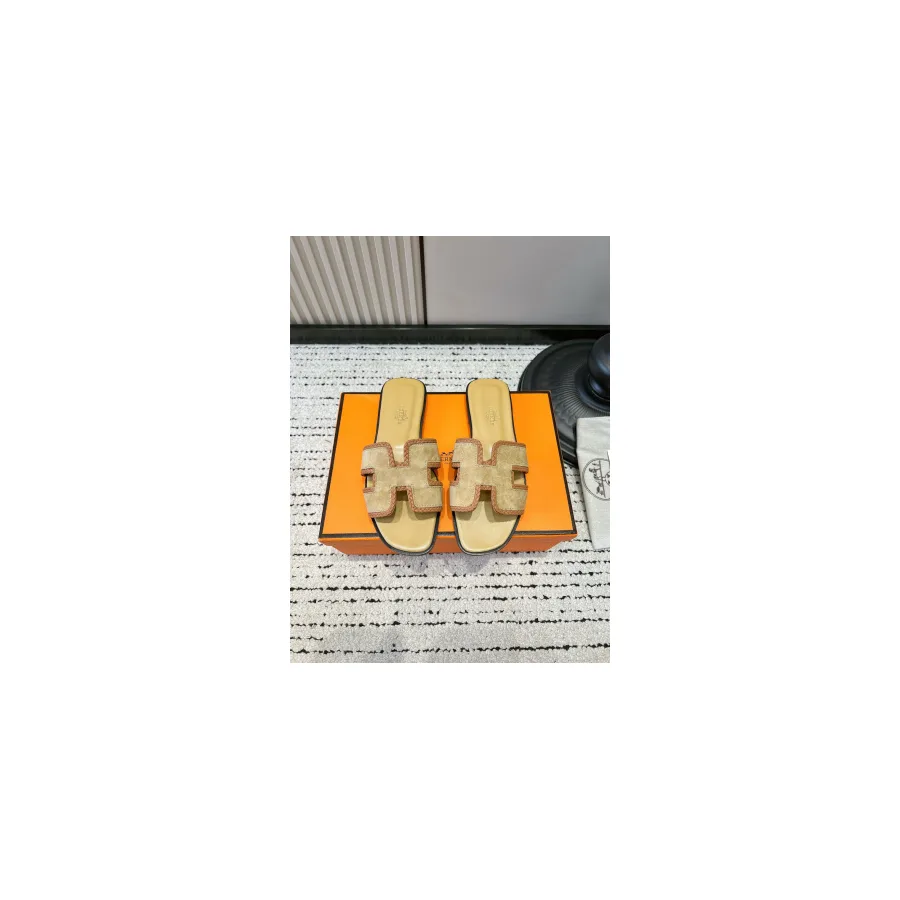
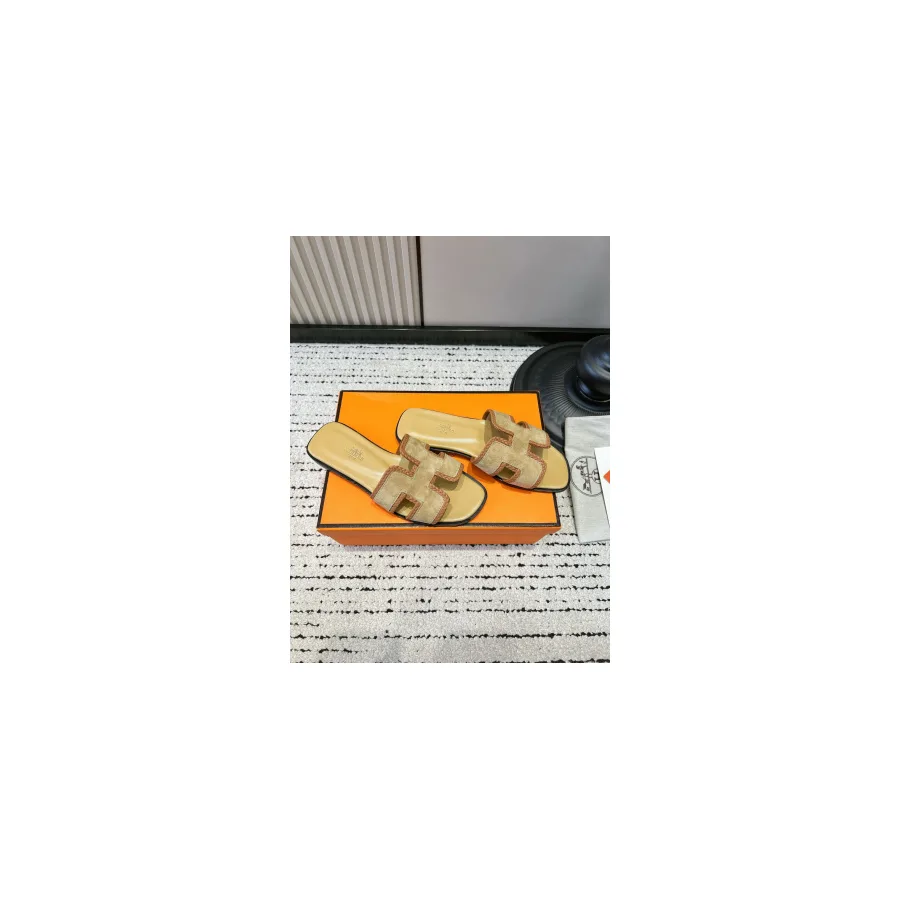
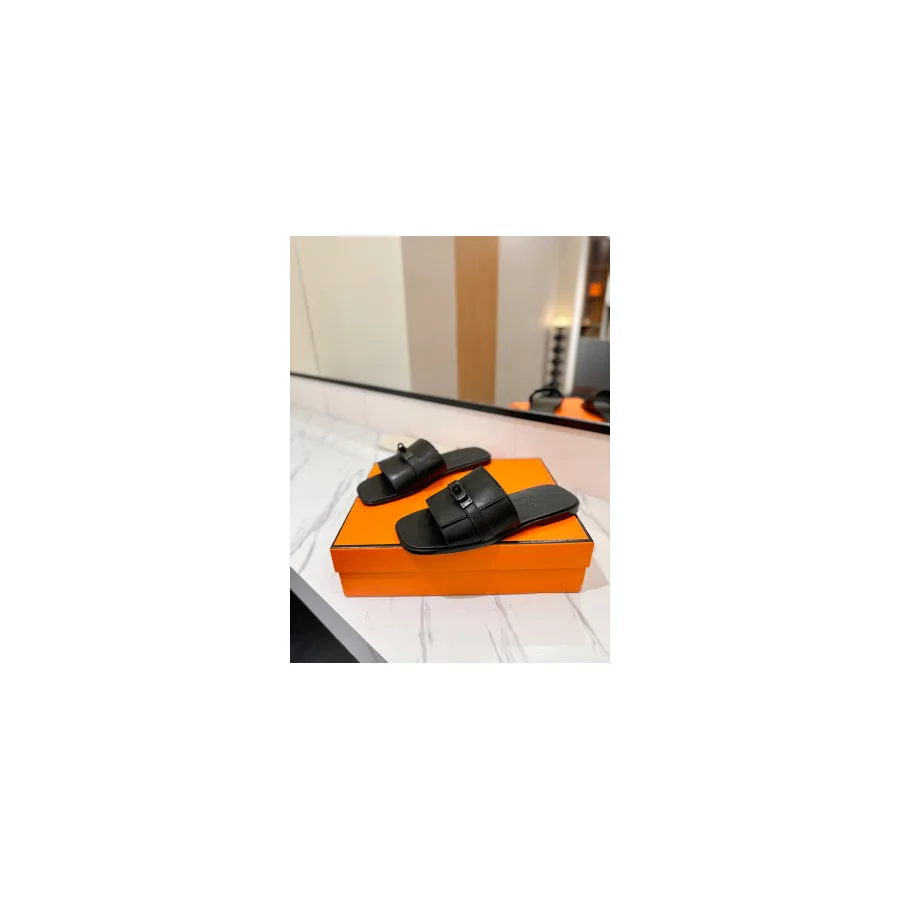
What no photograph settles is the two numbers that decide a purchase: the footbed length in centimetres and the label size of that individual pair. A size can be printed on the insole of some pairs and hidden under the footbed on others, and cameras in an album are pointed at the outside of the sandal. The useful request is not another photograph of the same angle but a ruler laid along the footbed from the inside of the heel to the front edge, quoted in centimetres.
The four details to send for a sandal size answer
A size question that gets settled in one reply carries four things. The model, because Oran, Chypre and Izmir are different constructions with different strap behaviour. The material, because a shearling-lined version takes up interior room a smooth calfskin one does not. The foot length in centimetres, measured standing and on the longer foot. And the number you normally take in a brand whose fit you know, which a seller can translate more reliably than any printed table.
With those four, the answer comes from the tables in this page plus the house’s one sentence. Without the centimetre figure, every party in the conversation is converting between letters, numbers and countries at least twice, and each conversion is a chance to move half a size.
Browse the Shoes Catalog or send the model, material and your foot length on WhatsApp. The published figures quoted above are reference data collected for research and checked on 29 September 2026, not a statement about any particular pair. For the same method applied to a closed shoe, the LV Trainer sizing guide traces a single model’s instructions across its references; the regional shoe size conversion guide covers the US, EU, UK and centimetre systems generally; the shoe construction and sole guide explains how a sole is attached and why that changes the feel of a size; and the Hermès belt size guide takes the opposite approach, because belt sizing is the one category where the house does publish the number.
Where the figures in this page come from
Every number above is attached to a page that prints it. Product pages were checked on 29 September 2026; colourways rotate, and a reference that has sold through may leave the list while its measurements and photographs remain useful.
| Source | What it establishes |
|---|---|
| Hermès: Oran sandal H021056Z 01340 | The Box calfskin build, the fit sentence in its shortest form, the leather sole and lining, and the note that the sole may differ between production batches |
| Hermès: Oran sandal H202272Z 27340 | The Epsom calfskin build, heel 0.4 in and front-to-heel 0.2 in, and the second line advising a size up between sizes |
| Hermès: Oran sandal H231288Z | The shearling version’s insole and lining, the same heel figures, and the 1997 date with the H cut credited to Pierre Hardy |
| Hermès: Oran sandal H202272Z BL370 (China) | The same model’s heel restated as 1 cm with a 0.5 cm front-to-heel difference |
| Hermès: Chypre sandal H222297Z v3R | Suede goatskin, anatomical rubber sole, adjustable strap, the shared fit sentence, heel 0.5 in |
| Hermès: Chypre sandal H222297Z BR360 (China) | The same family’s sole height as 1.2 cm, against 0.5 in on the US page |
| Hermès: Izmir sandal H211860Z HI2 | The men’s calfskin slide with the H cut-out and contrasting sole sides |
| Hermès: size guide FAQ | The scope of the house’s own size guide — enamel bracelets and belts, no footwear |
| Hermès: women’s sandals and men’s sandals | Which models sit on which line-up, and where the Oran’s ladder stops |
| Fashionphile: Oran sandal guide and size chart | The FR to US and UK ladder used above, the true-to-size prose, and the material list |
| sizedepo: Hermès women’s shoes and men’s shoes | A second women’s mapping and the men’s EU 39 to EU 46 ladder with millimetre figures |
| choozeshoe: Hermès shoe size chart | The chart that puts EU 37 at US 6 with a centimetre column, and the men’s EU 41 at US 9 |
| sizechartly: Oran sandal size chart | The same figures republished for the Oran specifically, with the note that the chart may describe the footbed rather than the foot |
| BagUSeek: Oran guide and Chypre guide | The foot-length column, the statement that the Oran is sized in the women’s ladder to EU 42, and the Chypre’s adjustable strap and sole construction |
| JULL: Oran sourcing notes | The UK 4 to UK 6 to EU 37 to EU 39 mapping and the note that the leather softens but does not gain length |
| Rebag: Oran sandal listing | A resale listing pairing US women’s 9.5 with IT 39.5, matching the chart row for FR 39.5 |
Frequent questions about Hermès sandal sizing
- Are Hermès Oran sandals true to size?
- Hermès answers this on every Oran page with the same line: choose your usual size, or size up a half size for a high instep, and on some references, size up if you are between sizes. Third-party tables do not agree with each other, so a US 7 buyer is told EU 37 by two of them and EU 38 by another. The house's own instruction sits between the two: keep your usual number, and move up half a step only if the instep is high or the feet are wide.
- What is a Hermès 37 in US sizing?
- A French 37 is a US 7 and a UK 4 on the Fashionphile conversion chart for the Oran, and a US 7 on the sizedepo table for Hermès women's shoes. Two other tables, from choozeshoe and sizechartly, print the same European 37 as a US 6. The centimetre figures attached to that row range from 23.5 cm to 24.0 cm, so an EU 37 is best treated as a foot of roughly 23.5 to 24 cm rather than as a fixed American number.
- Do Hermès sandals come in half sizes?
- Yes. The Oran is offered from EU 34 to EU 42 including half steps, which is exactly the step that the house's own fit sentence asks you to take when the instep is high. Half steps are also the reason two charts can both look plausible while disagreeing: a rounded conversion can land on either side of a 37.5, and the label on the box will still read 37.5 rather than 37 or 38.
- Do the Oran and the Chypre fit the same in the same size?
- No, even though both carry the identical fit sentence. The Chypre is built on an anatomical rubber sole with an adjustable strap across the foot, so the strap takes up a little of the length variation between two half sizes. The Oran has a fixed H cut-out, no adjustable fastening, and a leather sole, so the same half size moves the strap's position on the instep. A high instep is therefore a sizing problem on the Oran and a strap-setting problem on the Chypre.
- What is the men's version of the Oran?
- The Oran sits in the women's sandal line-up, from EU 34 to EU 42. The men's line-up runs the Izmir, a calfskin slide with the same H cut-out and contrasting sole sides, plus the men's Chypre, in a ladder that starts around EU 39 and reaches EU 46 and beyond. Men looking for the H-strap slide should size from the men's ladder, because the Oran stops short of the upper men's numbers.
- How should I measure a foot for a Hermès sandal?
- Stand on a sheet of paper with the heel against a wall at the end of the day, with the socks you intend to wear, and mark the longest toe; measure both feet and use the longer one. Read that centimetre figure against the tables in this page and take the larger row if it falls between two, then apply the house's sentence as an adjustment. On a flat sandal there is no heel counter or lacing to hold the foot, so leave a few millimetres of room past the longest toe and check that the heel sits fully on the footbed.
- What heel height do the Oran and Chypre have?
- The Oran page states a heel height of 0.4 inch with a front sole-to-heel difference of 0.2 inch, which the Chinese-language page for the same model restates as 1 cm and 0.5 cm. The Chypre is quoted at 0.5 inch on the US page and 1.2 cm on the Chinese page of the same model family, and 0.5 inch is 1.27 cm, so the two locales do not quite convert into one another. The practical difference between the two models is the sole: leather on the Oran, anatomical rubber at roughly 1.2 cm on the Chypre.