Catalog note: Album entries can change. Use the live album link and WhatsApp to confirm the current option before ordering.
A Hermès belt size is a length in centimetres, measured from the base of the buckle tongue to the middle of the strap's holes — not the total length of the leather and not your waist. Hermès itself says to measure a belt you already wear from the base of the tongue to the hole you use most, or to measure your waist where you wear the belt: an 85 cm waist corresponds to a size 85. Belts run from roughly 65 to 120 cm in 5 cm steps and come in widths from 13 mm to 42 mm, with the buckle and the reversible strap sold as separate pieces of a kit.
The first thing to know about a Hermès belt is that its size is a length in centimetres, and that length is measured to the middle hole — not to the end of the strap and not around your waist. The second is that a Hermès belt is really two purchases made at once: a buckle and a reversible strap, sold as separate pieces of a kit. Get those two facts straight and most of the sizing confusion around this belt disappears.
This guide covers what the centimetre number means, how Hermès tells you to measure, the full width range from 13 mm to 42 mm, the buckle lineup that runs from the letter-H to the Collier de Chien, and the leathers that change how the belt wears. The measurements and product details here are assembled from Hermès’ own size guide, from reseller references, and from independent sizing guides, and each claim is attributed below.
Why a Hermès size is not the length of the leather
The number stamped on a Hermès belt is the distance from the base of the buckle to the middle hole of the strap. It is not the total length of the strap, and treating it as the full length is the single most common way people order the wrong size.
Size Charts’ Hermès belt size page puts it directly: the centimetre figure runs from the tip of the buckle to roughly the third, or middle, hole, and that middle hole is where you should wear the buckle. Because the strap continues several centimetres past the last hole and tapers to a tip, the physical piece of leather is always longer than the number suggests. A size 90 belt, in other words, is not a 90 cm strap — it is a strap that fastens at a point 90 cm from the buckle.
This is the opposite of how trouser sizing works, and it is worth repeating in a sizing conversation: the number describes where the belt fastens, not how long the leather is.
The two ways Hermès tells you to find your size
Hermès’ own size guide gives two acceptable methods, and both are simple. The official Hermès FAQ size guide says belts are sized in centimetres, and recommends measuring one of your own belts from the base of the tongue to the hole you use most. As an alternative, it says you can measure your waist circumference at the point where you normally position your belts — so a waist that measures 85 cm corresponds to a Hermès size 85.
The first method is the more reliable of the two, because it copies a fit you already know works. Lay a belt you wear comfortably flat, measure in centimetres from where the leather meets the buckle to the hole you actually use, and that number is your Hermès size. The second method is a reasonable fallback when you do not own a reference belt, but it assumes you always wear the belt at the same height; a belt worn low on the hips needs a longer size than the same belt at the natural waist.
Sizes are offered in 5 cm steps. Lab Luxury Resale lists the run from 60 cm up to 120 cm, and Size Charts extends the same logic to 125 cm. In practice the sizes you will see most often are 75, 80, 85, 90, 95, 100 and 105. As a rough waist mapping — where the buckle reaches the middle hole — independent guides put 80 cm at roughly a 32-inch waist, 85 cm at 34, 90 cm at 36, 95 cm at 38, 100 cm at 40, and so on (Size Charts, Mythcon). To convert a centimetre size to inches, divide by 2.54.
The kit: buckle and strap are two separate decisions
The structural fact that sets Hermès belts apart from most belts is the modular kit. A buckle and a reversible strap are sold separately, so the belt you end up wearing is the result of two choices, not one. Beltley’s guide to reversible Hermès belts confirms this: the buckle and the strap are separate pieces, and reversible straps span widths from 13 mm to 38 mm in leathers such as Togo, Epsom, Box and Swift.
Two consequences follow. First, the width of the strap must match the buckle — a 42 mm Constance 2 buckle will not take a 24 mm Mini Constance strap, so the two halves of the kit have to be chosen together. Second, because one strap carries two faces, the single belt is effectively two colours or two finishes. A black Box calfskin face on one side and a gold Togo face on the other is a common pairing, and the buckle rotates so you can show whichever side suits the outfit.
This also means the “belt” in a catalog photo is usually one strap plus one buckle already assembled. When you ask about a specific piece, the two useful questions are which two faces the strap carries, and whether the buckle is fixed or turns — most Hermès buckles turn, but confirming removes the assumption.
Widths from 13mm to 42mm, and what each carries
Hermès does not make one width of belt. The reversible system spans 13 mm to 38 mm, with the Constance 2 pushing to 42 mm. The three widths that dominate the searches and the listings are 24 mm, 32 mm and 42 mm, and each reads differently.
The 24 mm strap is the slim option, paired with the Mini Constance or Mini H buckle. It slides through the narrow loops of suit trousers and tailored trousers, and it reads as the dress belt of the line. The 32 mm strap is the centre of the range and the one most often seen in mainstream fashion, carrying the classic H buckle. It is wide enough to read as a statement on denim but still fits most standard belt loops. The 42 mm strap is the widest, carrying the Constance 2 buckle, and is aimed mostly at men; it is noticeably heavier and sits differently on the body. These three tiers come from Size Charts, and Apart Style’s 24 mm vs 32 mm comparison adds the practical note that the extra 8 mm between 24 mm and 32 mm changes the visual weight far more than the number suggests — the 32 mm is a focal point, while the 24 mm stays a supporting detail.
The full reversible range is finer-grained than the three tiers. Beltley maps it as 13 mm (Collier de Chien, Carrousel, Mini 5382), 24 mm (Mini H, Canaille), 32 mm (H buckle women’s, Cape Cod 32) and 38 mm (H buckle men’s, Constance 38, Quentin, Lucky 15). One fit detail follows from the width: Mythcon notes that a wide 42 mm belt sits higher on the hip and covers more surface area, so it can feel tighter than a narrow 24 mm strap of the same length — the width changes the effective fit even when the centimetre number is identical.
The buckle lineup, from the H to the Collier de Chien
The buckle is the part of the belt people remember, and Hermès offers several, most of them named after its bags and jewellery. Spotted Fashion’s Hermès belt reference guide breaks the line down clearly.
The H buckle is the plain letter-H, usually on a 32 mm reversible strap in Swift, Epsom or Box. The Constance is a different buckle — a squared C shape inspired by the Constance bag — offered as a 24 mm Mini Constance and a 42 mm Constance 2. The Collier de Chien, named after the brand’s studded dog-collar bracelet, appears as a wide 49 mm strap with a palladium or gold-plated buckle and also as a 32 mm reversible strap. The Chaine d’Ancre, built around the chain-link anchor motif, comes in a 32 mm version, and the Quizz and Gamma 32 are two more 32 mm straps carrying H buckles in different finishes.
Because so many of these share a width, the buckle is what tells two otherwise similar belts apart. A 32 mm strap could be an H buckle, a Chaine d’Ancre, a Quizz or a Gamma 32, and they are distinguished only by the shape of the metal — which is exactly what a close-up photo of the buckle should resolve.
The leathers that change how a belt wears
The strap leathers matter because they decide how the belt ages. Spotted Fashion lists Box, Swift, Epsom, Togo, Evercolor, Chamonix, Tadelakt and Porosus crocodile across the line, and the four you will encounter most are Box, Epsom, Togo and Swift.
Box calfskin is a smooth, firm leather with a polished surface; it is the dressiest of the group and shows surface marks more readily. Epsom is a stamped calfskin with a fine grain that hides scratches well and holds its shape, which makes it a common choice for a belt that sees daily use. Togo is a softer grained calfskin with more give, and Swift is a supple, fine-grained leather that takes colour deeply. The practical difference is in how the strap behaves over time: a firmer leather such as Epsom holds its line and its holes more crisply, while a softer leather such as Swift or Togo will relax and may show the bend at the most-used hole sooner. A belt that feels a little tight on arrival will generally loosen slightly as the leather breaks in — Size Charts notes that leather belts stretch over time, which is a small argument for rounding up rather than down when you are between sizes.
Measuring without guessing
The reliable path is to copy a fit you already have rather than to estimate. Lay a belt you wear comfortably flat, measure in centimetres from the base of the buckle tongue to the hole you use most, and order that number. Do not measure the full strap end to end, and do not include the buckle length in the measurement — both overstate the size.
Hole spacing matters here. Hermès detachable straps typically carry three holes, and classic stitched belts carry five, with holes spaced about 2.5 cm (one inch) apart (Cipriani Leather). That means a belt fastens at the middle hole with roughly one hole of adjustment either side on a three-hole strap, and two holes either side on a five-hole strap. If you are between two sizes, round up — a wider belt can be punched, but a short strap cannot be lengthened.
What to look for in a catalog photo
A photo of a Hermès belt can settle the two questions that matter most, but only if it is taken the right way. A close-up of the buckle front and back tells you which buckle it is — an H, a Constance C, a Chaine d’Ancre or a Collier de Chien — and whether the finish reads as gold or palladium. A shot of the strap laid flat with a ruler confirms the width in millimetres and the number of holes. A shot of the strap tip with the size stamp confirms the centimetre size.
What a photo cannot settle is fit and wear. It cannot tell you whether the strap will crease at your most-used hole, how the two faces of a reversible strap actually look in daylight, or whether the size will sit correctly at your hip versus your natural waist. For those, the measurement of a belt you already wear is the better reference than any photo.
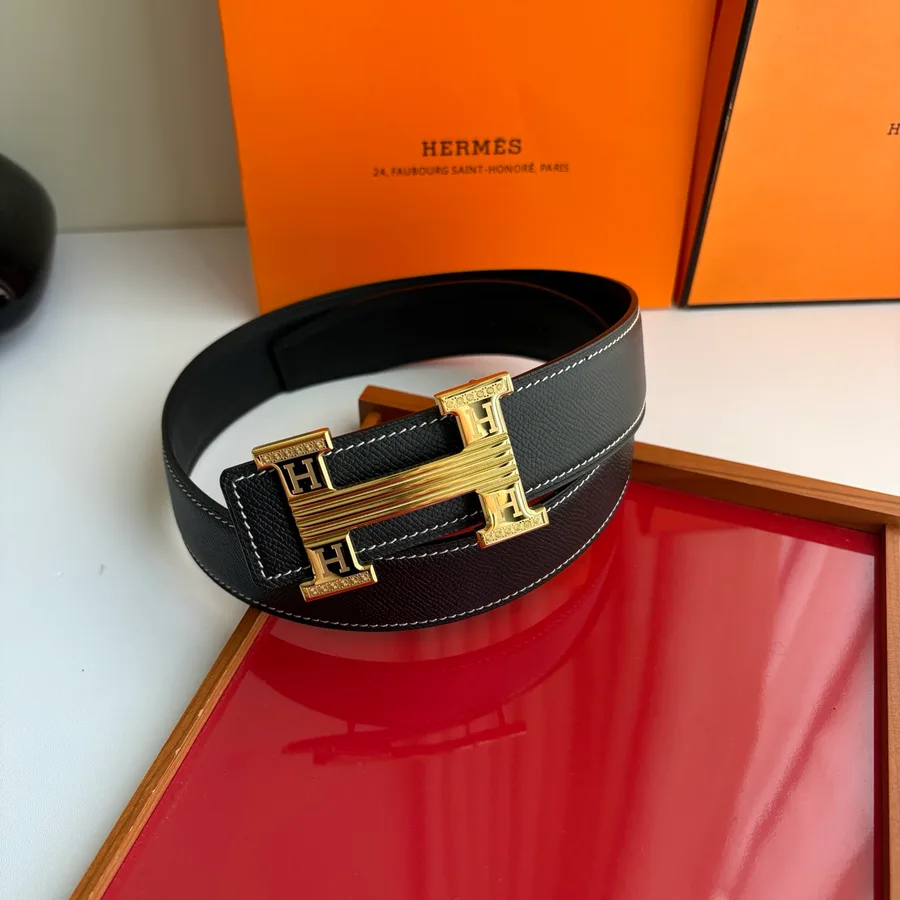
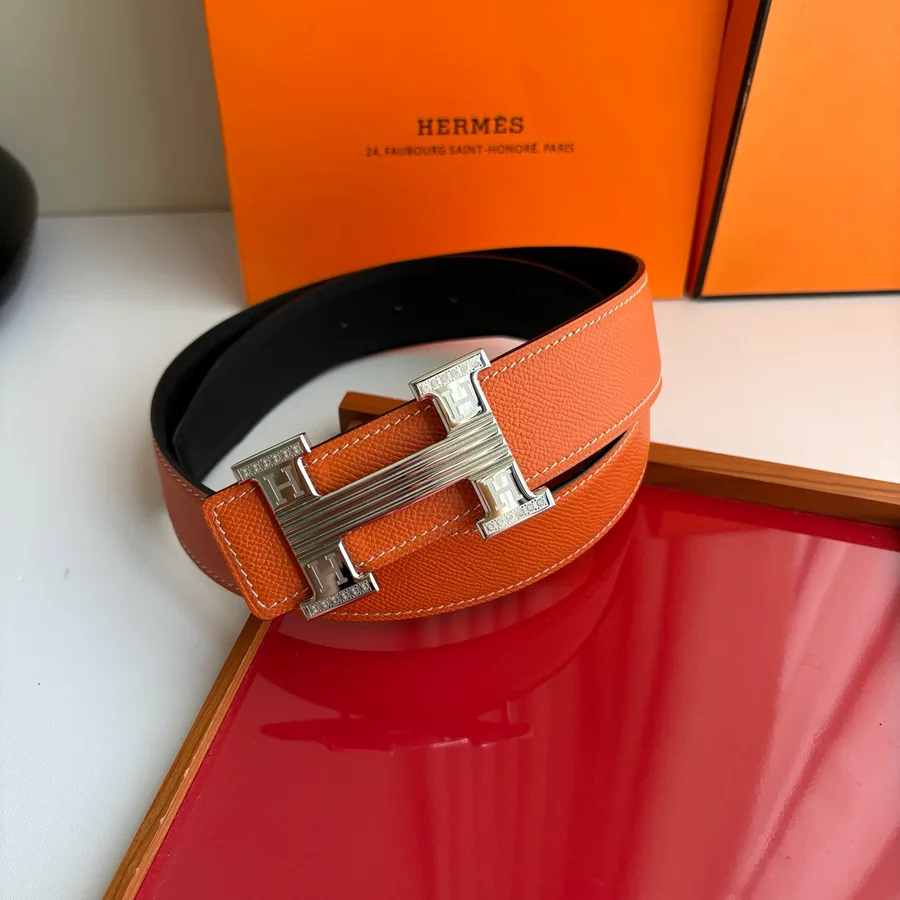
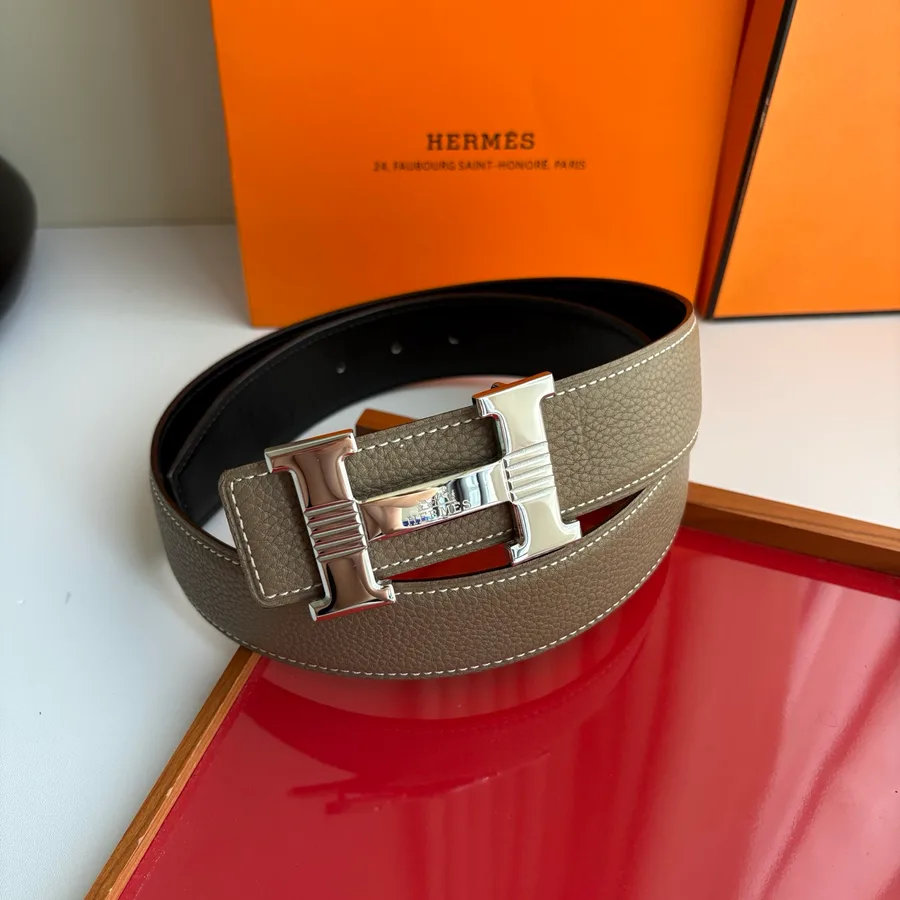
Start with the length, then the width, then the buckle. The single most useful number is the measurement, in centimetres, from the buckle base of a belt you already wear to the hole you use most — order that size and round up if you are between sizes.
Browse the Belts Catalog or send your reference on WhatsApp. Include the catalog screenshot, your preferred width and buckle shape, and the centimetre length of a belt you already wear, measured from the buckle base to your most-used hole. Ask which two faces the strap carries, whether the buckle turns, and for a close-up of the buckle front and back. The source links above are research references, not GunongTrade inventory records.
Frequently asked questions about Hermès belt sizes
- What does the size number on a Hermès belt mean?
- It is a length in centimetres measured from the base of the buckle to the middle hole — the third of five holes — not the full length of the strap. A size 85 is 85 cm from the buckle to the centre hole, and the leather itself runs several centimetres longer past that point.
- How do I find my Hermès belt size?
- Measure a belt you already wear well from the base of the buckle tongue to the hole you use most, and match that in centimetres. Hermès also accepts a waist measurement taken where you normally wear the belt, so an 85 cm waist reads as a size 85. If you fall between two sizes, round up.
- What widths does the Hermès belt come in?
- Reversible straps run from about 13 mm up to 38 mm, and the wider Constance 2 reaches 42 mm. The three widths you will see most are 24 mm (Mini Constance), 32 mm (the classic H buckle, worn by both men and women), and 42 mm (Constance 2, aimed mostly at men).
- Are Hermès belts reversible?
- Most of them are. A single strap carries one leather colour or finish on each face, and the buckle turns so you can show either side. The strap and buckle are sold as separate parts of a kit, which is why you can mix widths, leathers and buckles.
- Is the H buckle the same thing as the Constance belt?
- They are related but not identical. The H buckle is the plain letter-H buckle, usually on a 32 mm reversible strap. The Constance is a different buckle shaped like a squared C, offered as a 24 mm Mini Constance and a 42 mm Constance 2. People often call any Hermès belt a 'Constance belt', but the buckle is the part that distinguishes them.
- How many holes does a Hermès belt have?
- Hermès detachable straps typically carry three holes, while classic stitched belts carry five. Holes are spaced about 2.5 cm (one inch) apart, which is why the middle hole is the reference point the size number describes.