Catalog note: Album entries can change. Use the live album link and WhatsApp to confirm the current option before ordering.
A Dior belt size is a strap length in centimetres, not a waist measurement. Current Dior belts are sold from 80 to 120 cm in 5 cm steps, and many straps carry two numbers: a 90/36 tag means a 90 cm strap, which is 35.4 inches, so the second figure is the same length in inches rather than a trouser size. Width is a separate decision across 10, 15, 20, 25, 30 and 35 mm, and Dior prints the buckle for each: 4.7 x 3 cm on the 25 mm 30 Montaigne, 5.8 x 3.4 cm on the 30 mm, 6.9 x 4.1 cm on the 35 mm.
A Dior belt is sized by a strap length in centimetres, sold from 80 to 120 cm in 5 cm steps across the current lines, with strap widths of 10, 15, 20, 25, 30 and 35 mm. The tag often carries two numbers, and 90/36 is one belt, not two sizes.
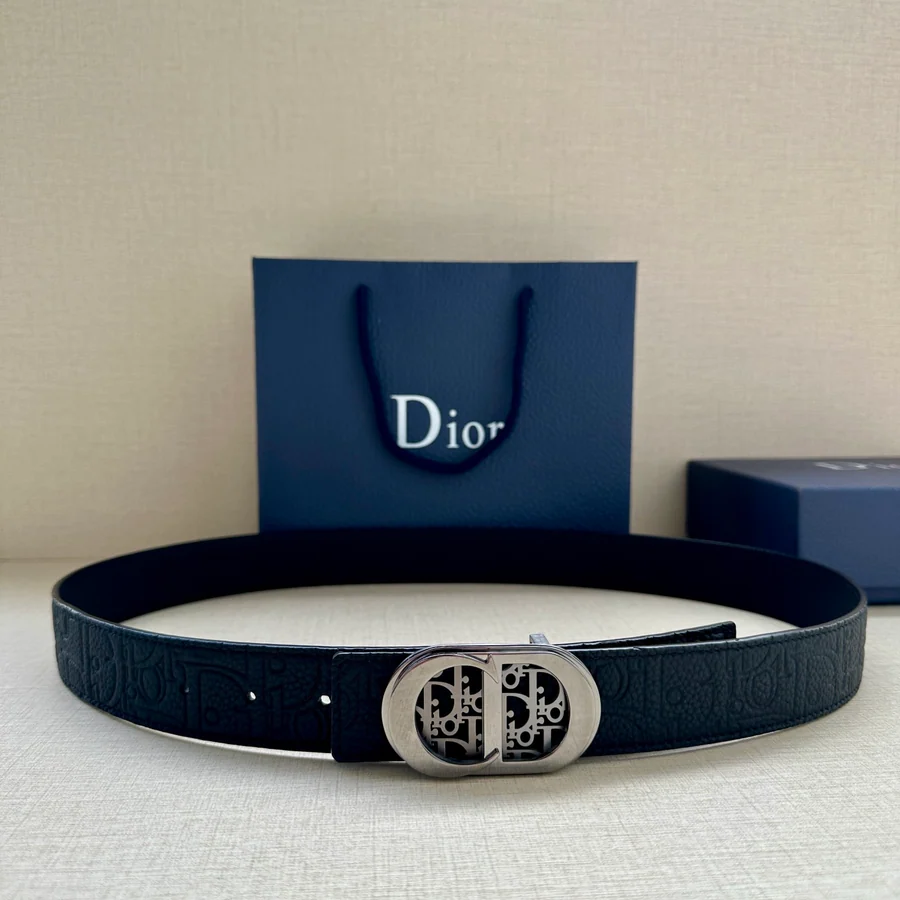
Three decisions sit behind that single tag, and they are independent of each other. The first is width: Dior’s women’s belt pages run across 10, 15, 20, 25, 30 and 35 mm straps, and the width decides which belt loops will take the piece, because the buckle is taller than the strap is wide. The second is length, printed in centimetres, which is the strap and not the body. The third is construction: a flat strap stitched to a buckle behaves differently from a reversible one that swivels, since the reversible piece has both faces finished and two removable loops that can be swapped for a tonal or a contrasting pair. Get the order wrong and the belt arrives in the right style and the wrong size, which is the mistake worth spending five minutes to avoid.
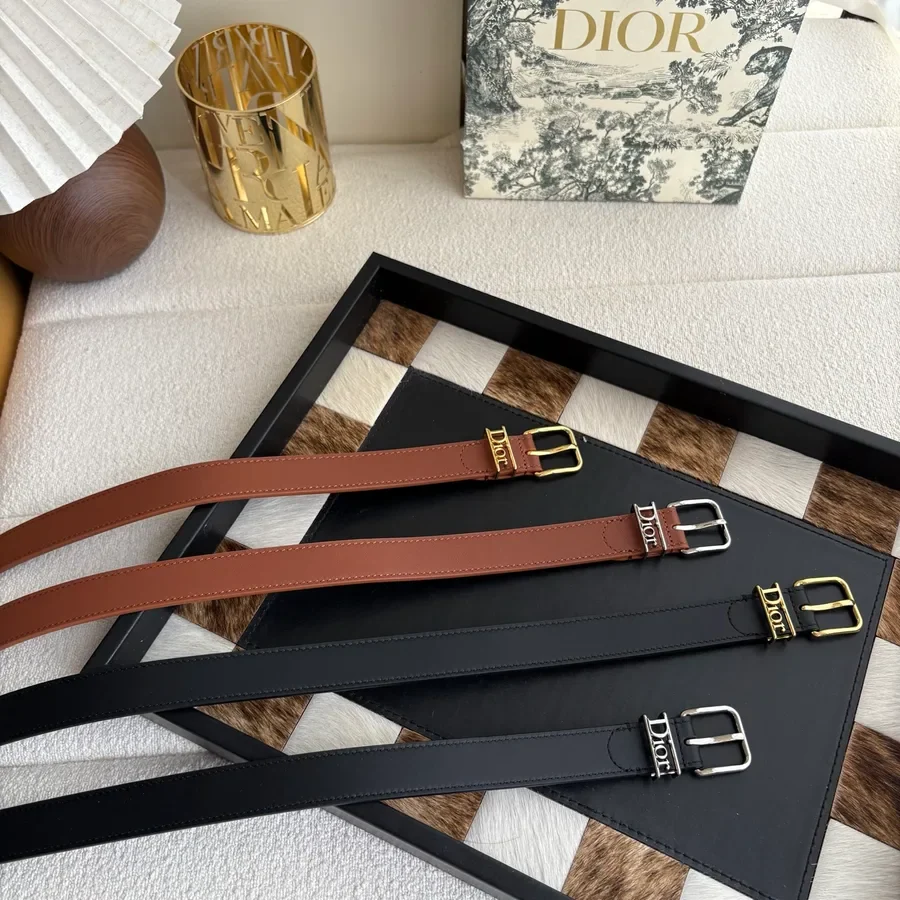
Six strap widths, and the buckle height that decides which loops take them
Dior prints a width on every belt block, in millimetres and in inches together, and it prints a buckle measurement on most of them. Put the two side by side and the practical rule falls out: the strap width is what you see, the buckle height is what has to pass through a trouser loop.
| Model as Dior lists it | Strap width | Published buckle | Composition as printed |
|---|---|---|---|
| 30 Montaigne, smooth calfskin (B0422UBVW_M900) | 25 mm / 1 in | 4.7 x 3 cm / 2 x 1 in | 90% calfskin, 10% brass |
| 30 Montaigne, Cannage calfskin (B0436UWHN_M030) | 30 mm / 1.2 in | 5.8 x 3.4 cm / 2.5 x 1.5 in | 80% calfskin, 20% brass |
| 30 Montaigne Reversible, calfskin and Dior Oblique jacquard (B0447UWEO_M928) | 35 mm / 1.4 in | 6.9 x 4.1 cm | 40% calfskin, 40% cotton, 10% brass, 5% polyamide, 5% polyester |
| 30 Montaigne Reversible, smooth calfskin (B0178UWGA_M911) | 20 mm / 0.8 in | 5 x 3 cm / 2 x 1 in | calfskin |
| Dior Médaillon, smooth calfskin (B1022QGBK_M67M) | 25 mm / 1 in | 5.2 x 7.3 cm as printed | calfskin, brass |
| CD Classy, Cannage suede calfskin (B1004CGBN_M66M) | 30 mm / 1.2 in | not published | 80% suede calfskin, 20% brass |
Read the third column rather than the second. A 25 mm strap with a 3 cm buckle needs about 3.2 cm of clear opening to pass a loop without scraping; the 35 mm reversible carries 4.1 cm of buckle height, so it wants a loop nearer 4.3 cm. Denim loops are usually generous, dress-trouser loops are not, and the buckle is the part that catches. That is why two belts that look similar in a photograph can behave differently on the same pair of trousers, and why the width alone is a weaker guide than the width plus the buckle figure.
Why a Dior tag reads 90/36, and why 36 is not your waist
The paired tag is a translation, not a second size, and the arithmetic is the proof. Ninety centimetres divided by 2.54 is 35.4 inches. Dior and the resale catalogues that reproduce its labels round that to 36 and print it beside the centimetre figure, so 90/36 describes one strap measured twice. The same arithmetic holds down the ladder: 80 cm is 31.5 inches, 85 cm is 33.5, 95 cm is 37.4, 100 cm is 39.4, 105 cm is 41.3, 110 cm is 43.3, 115 cm is 45.3 and 120 cm is 47.2. Every printed inch figure is the centimetre figure converted, and none of them is a waist. Put a 90 cm strap around a 90 cm body and there is no tail left to fasten, which is the second proof that the tag cannot be a body measurement.
That single point explains most of the contradiction in published Dior belt charts. One widely copied conversion table pairs the 90 cm strap with a US 36 in its own right-hand column and then answers the question “what is a 90/36 Dior belt” by telling the reader to buy a 100 to fit a 36 jean — two different answers to one question, because the table’s inch column is the strap length while the advice is aimed at the trouser size. The two figures sit one size apart on the same ladder, and a buyer who reads the first as a waist buys a strap about 10 cm short.
The 5 cm ladder from 80 to 120, and the 2.5 cm inside each size
Dior does not publish a single consolidated belt chart on a fetchable page; the sizes appear as selectable options on each product block, and reseller catalogues that mirror Dior’s own references list the same run for the 20 mm, 25 mm and 35 mm 30 Montaigne styles: 80, 85, 90, 95, 100, 105, 110, 115 and 120 cm. A vintage Dior Oblique belt catalogued at size 75 shows the ladder extends below 80 on older pieces, and one third-party chart prints 65 to 125.
| Strap size | Same length in inches | Waist a chart pairs it with | What that means in practice |
|---|---|---|---|
| 80 cm | 31.5 in | US 30 in some charts, US 32 in others | a slim waist worn at the natural waistline |
| 85 cm | 33.5 in | US 32 or 34 | the common middle of the women’s range |
| 90 cm | 35.4 in | US 36 printed beside it, US 32 to 34 in waist columns | the size most often misread as a 36 waist |
| 95 cm | 37.4 in | US 38 printed, 34 to 36 waist columns | low-rise wear and thicker waistbands |
| 100 cm | 39.4 in | US 40 printed, 36 to 38 waist columns | the figure the “add two inches” rule lands on for a 36 trouser |
| 105 to 120 cm | 41.3 to 47.2 in | US 42 to 48 printed | worn at the hip rather than the waist |
The ladder is 5 cm wide at every step, and a strap normally carries five holes, which spreads the adjustment across 10 cm. That is a wider window than the step suggests, but it is not a licence to size down: the strap still has to reach a hole with the tail resting inside the loops, and a strap fastened on its last hole announces itself in every photograph. Where the published data runs out — Dior does not print hole count or hole spacing on the blocks checked — the only honest answer is to ask the seller for both.
Reversible straps, the swivel buckle, and the length you cannot take back
The reversible 30 Montaigne is described by Dior as working through a swivel mechanism, with two removable loops that can be worn in a tonal or a contrasting way. That construction is the reason the length decision deserves more care here than on a single-face belt: both sides of the strap are finished, and the buckle turns rather than being stitched to one face.
On an ordinary belt, a size that lands one hole too long can sometimes be shortened at the buckle end, because that end is hidden under the buckle once it is fastened. On a reversible strap the same cut removes finished surface, and the stitching that keeps both faces in order. Dior does not promise shortening on these blocks, so the sensible reading is that the removable loops are the only changeable part and the size has to be right. A 35 mm reversible with a 6.9 cm buckle also has less room to hide a poor length choice than a 20 mm strap, because more leather shows on either side of the buckle, and on a reversible piece both of those visible faces are the finished product rather than a hidden lining that can absorb a repair.
Two buckle figures for two 25 mm belts: 4.7 x 3 cm and 5.2 x 7.3 cm
Both the 30 Montaigne and the Dior Médaillon are published as 25 mm straps, and both print a buckle figure — but not figures that can be compared at face value. The 30 Montaigne block gives 4.7 x 3 cm, labelled length by height. The Médaillon block gives 5.2 x 7.3 cm in the same slot. A 25 mm strap cannot carry a buckle 7.3 cm tall and 5.2 cm long in the same proportion as the other, so one of the two blocks is formatted differently rather than describing a materially larger buckle.
The practical consequence is narrow but real: if you are choosing between two 25 mm belts by reading the buckle numbers, you are not comparing like with like. Compare the photographs instead, and use the one figure that is unambiguous — the strap width, printed in millimetres and inches on every block — to decide what will pass a loop. On the 30 mm and 35 mm 30 Montaigne straps the buckle figures scale with the strap (5.8 x 3.4 cm and 6.9 x 4.1 cm), so the ordering there is trustworthy.
Cannage suede, jacquard and canvas: the blocks that print no buckle figure
The CD Classy in chocolate Cannage suede calfskin prints its width, 30 mm, and its composition, 80% suede calfskin and 20% brass, but no buckle dimensions at all. The reversible 35 mm 30 Montaigne prints 6.9 x 4.1 cm and a five-part composition that includes cotton, polyamide and polyester alongside calfskin and brass, because half of that strap is jacquard rather than leather. The 20 mm reversible prints 5 x 3 cm.
Suede changes the fit question rather than the size question. A suede strap is a hair thicker than a smooth calfskin strap of the same width, and it does not slide through a loop as freely, so a suede 30 mm feels firmer on the waist than the calfskin 30 mm does. None of that moves the centimetre number on the tag, but it is the reason two belts in the same size can feel different after an hour of wear, and worth knowing before assuming a size that worked in smooth leather will behave the same in suede.
What a belt photograph settles, and the three numbers it never shows
A catalogue photograph of a belt is unusually informative about width and unusually silent about length. The strap against the buckle gives the width away immediately, and the buckle’s proportion to the strap does too: a 4.7 cm buckle dwarfing a 25 mm strap reads very differently from the same buckle on a 35 mm strap. Folding, coiling and the way the tail hangs are also visible, and a strap that has been worn hard shows its crease at one hole, which tells you where the previous owner fastened it.
What the photograph never shows is the number. Length, hole count and hole spacing are all invisible at catalogue scale, and a coiled belt gives no reliable sense of 90 cm against 100 cm. The tag on the interior is the only place the centimetre figure appears — Dior prints its signature inside, and the size sits with it — so a listing with no photograph of the interior tag has not told you the size, whatever the description says.
Four answers to get from a seller before a Dior belt changes hands
Ask for the interior tag photograph, the strap length in centimetres from the buckle to the middle hole, the hole count and the buckle height. Those four answers settle everything the photographs cannot, and three of them can be checked against the figures above without any expertise.
If the tag reads 90/36, the strap is 90 cm and the second number is decorative. If the seller measures 95 cm from the buckle edge to the hole most used, the strap is a 95. If the holes number five and span 10 cm, the working range is roughly the size plus or minus 5 cm. And if the buckle height comes back at 4.1 cm on a strap described as 35 mm, the loops on the trousers in your wardrobe are the only remaining question — which is why the next message is usually a photograph of a belt loop with a tape measure against it.
Where the Dior belt figures on this page were read
Every figure above is a reading of a published page checked on 26 October 2026, and where two sources describe the same thing differently, both readings are printed rather than averaged.
- Dior’s product block for the 30 Montaigne belt in black smooth calfskin, reference B0422UBVW_M900: width 25 mm / 1 in, buckle 4.7 x 3 cm / 2 x 1 in, 90% calfskin and 10% brass, made in Italy
- Dior’s product block for the 30 Montaigne belt in latte Cannage calfskin, reference B0436UWHN_M030: width 30 mm / 1.2 in, buckle 5.8 x 3.4 cm / 2.5 x 1.5 in, 80% calfskin and 20% brass, made in Italy
- Dior’s product block for the 30 Montaigne Reversible belt in blue smooth calfskin and Dior Oblique jacquard, reference B0447UWEO_M928: width 35 mm / 1.4 in, buckle 6.9 x 4.1 cm, swivel mechanism, two removable loops, 40% calfskin, 40% cotton, 10% brass, 5% polyamide and 5% polyester
- Dior’s product block for the CD Classy belt in chocolate Cannage suede calfskin, reference B1004CGBN_M66M: width 30 mm / 1.2 in, CD Classy buckle with the Dior signature engraved in black lacquer, no buckle dimensions published
- Dior’s product block for the Dior Médaillon belt in brown smooth calfskin, reference B1022QGBK_M67M: width 25 mm / 1 in, buckle printed as 5.2 x 7.3 cm, brass detailing
- Dior’s women’s belt category pages, read October 2026: the widths on offer across the range at 10, 15, 20, 25, 30 and 35 mm, and the 30 Montaigne Reversible 20 mm block at 5 x 3 cm of buckle
- A reseller catalogue mirroring Dior references, read October 2026: sizes 80, 85, 90, 95, 100, 105, 110, 115 and 120 cm offered on the 20 mm, 25 mm and 35 mm 30 Montaigne styles
- Resale listings, read October 2026: Dior men’s belts tagged 90/36, and a vintage Christian Dior Oblique belt listed at size 75 with the size described as the distance from buckle to centre hole
- A third-party Dior belt conversion table, read October 2026: 65 to 125 cm against US and international columns, used above only to show where its two answers disagree
- A collector’s measurement of a 2005-era Dior Homme belt, read October 2026: at size 85 the first hole sits 81.5 cm from the inner tip of the buckle and the last at 91.5 cm; at size 90 the same two points are 86.5 cm and 96.5 cm, a 10 cm span over five holes
Browse the accessories catalog or send the interior tag and the strap length on WhatsApp. The Hermès belt size guide covers a house that sells buckle and strap as separate pieces, the Gucci belt size chart works through two ladders that disagree at every step, and the belt leather and construction guide explains what the layers and stitching inside a strap are doing.
Frequently asked questions about Dior belt sizes
- What does the size number on a Dior belt mean?
- It is a strap length in centimetres, taken to a reference hole rather than to the end of the leather, which is why a 90 does not fit a 90 cm waist. Buyers' guides and resale listings describe the reference point as the centre hole, and the arithmetic supports that: a 90 cm strap with five holes sits 5 cm either side of its centre, so the wearer has roughly 85 to 95 cm of working length. The figure printed on the tag is therefore the strap, and the body measurement you need is the one you take with a tape where the belt will actually sit.
- Is a Dior belt size 90 the same as a 36 waist?
- No. The 36 in a 90/36 tag is the same strap length expressed in inches: 90 cm divided by 2.54 is 35.4 inches, rounded to 36 on the tag. A 36 inch trouser waist needs a strap longer than 90 cm, closer to 95 or 100 cm, because the strap has to travel around the body plus the thickness of the waistband and still reach a hole with some tail left over. Reading the second number as a waist size is the single most common way a Dior belt is bought a size short.
- How wide are Dior belts?
- The current women's range is published in six widths: 10, 15, 20, 25, 30 and 35 mm. The 20 mm and 25 mm straps carry the 30 Montaigne, Dior Médaillon, CD Icon, Saddle and Dior Oblique lines, the 30 mm strap carries CD Classy and the Cannage 30 Montaigne, and the 35 mm strap is used on the reversible 30 Montaigne. Ten millimetres is a chain or very fine strap; 35 mm is the widest of the leather belts on Dior's women's pages.
- Which Dior belt width fits suit trousers?
- A 20 mm or 25 mm strap is the safer choice for tailored trousers, and the number that decides it is the buckle height rather than the strap width. Dior publishes 3 cm of buckle height on the 25 mm 30 Montaigne and 4.1 cm on the 35 mm reversible, so the wide strap needs a loop opening comfortably over 4 cm. A 35 mm strap will pass through most denim loops and stall on a narrow dress-trouser loop that a 25 mm strap clears easily.
- Can a Dior reversible belt be shortened?
- Ask before assuming it can. Dior describes the reversible 30 Montaigne as working through a swivel mechanism with two removable loops, which means both faces of the strap are finished leather or jacquard and the buckle turns rather than being stitched to one side. Shortening at the buckle end removes finished material and the stitching that holds it, so a reversible strap is the last place to gamble on length. The removable loops are the only part Dior describes as changeable.
- Why do two Dior 25 mm belts publish different buckle measurements?
- Because the printed fields are not always formatted the same way. The 25 mm 30 Montaigne publishes 4.7 x 3 cm, while the 25 mm Dior Médaillon publishes 5.2 x 7.3 cm on its own product block. Both are 25 mm straps, so the second figure cannot describe the same measurement in the same order; treat any cross-model buckle comparison as a check against the photograph until the two blocks are read side by side.