Catalog note: Album entries can change. Use the live album link and WhatsApp to confirm the current option before ordering.
A Gucci belt size is a length in centimetres, measured from the outer edge of the buckle to the third — middle — hole of the strap. A size 90 is 90 cm to that hole and sits well short of a 90 cm waist. Gucci publishes a women's ladder of 65–120 cm and a men's ladder of 75–120 cm in 5 cm steps, where the same 90 cm strap reads US 28 on the women's chart and US 32 on the men's.
What changed?
- October 3, 2026: Rebuilt around Gucci's own belt size pages: the women's 65–120 cm ladder and the men's 75–120 cm ladder with every published column, the measuring rule Gucci prints for Double G and standard buckles, the strap widths published in inches rather than centimetres, and the buckle dimensions per tier.
A Gucci belt’s size number is a length in centimetres, and Gucci says exactly which length: for Double G styles, from the outer edge of the buckle to the third hole of the strap; for standard buckle belts, from the start of the strap to the third hole. A size 90 is 90 cm to that hole, which is why the figure always reads longer than the waist it fits.
Two details make or break a size decision here. The first is that not every strap has five holes — Gucci’s own guidance notes that some carry five standard holes and others only three, so “the third hole” is not always the middle of the adjustment range. The second is that Gucci publishes two ladders, and they disagree about what a given length means: the women’s chart runs 65–120 cm and prints US 28 against the 90 cm strap, while the men’s chart runs 75–120 cm and prints US 32 against the same 90 cm.
Everything below comes from Gucci’s own belt size pages and product pages, cross-checked against independent sizing references. Both ladders are printed in full with every column Gucci publishes, and where two sources describe the same thing differently, both readings are shown rather than averaged.
Gucci publishes two belt ladders rather than one, and they disagree about what a given length means. The women’s chart runs from 65 cm to 120 cm in 5 cm steps, printing trouser equivalents in US, IT, EU and UK sizes beside each step as well as a jeans column: the 90 cm strap reads US 28 and jeans 30 there. The men’s ladder starts at 75 cm and ends at 120 cm, and the same 90 cm strap reads US 32 and jeans 32. Both charts measure the strap the same way — for Double G styles from the outer edge of the buckle to the third hole, for standard buckle belts from the start of the strap to the third hole. Not every strap carries five holes: Gucci notes that some have three, so the third hole is not always the middle of the adjustment range.
The number is a length, and Gucci names the hole to stop at
Gucci’s size page gives the measuring rule in its own words, and the wording matters: for Double G styles you measure from the outer edge of the buckle to the third hole of the strap; for standard buckle belts you measure from the start of the strap to the third hole. Older versions of the same page put it more loosely — from the start of the buckle to the middle hole — and a large retailer echoes that as “from the end of the buckle to the centre hole”.
So the definition is stable even where the phrasing is not: the number is a strap length ending at a specific hole, not a body circumference. Three practical consequences:
- The strap is longer than the number. The leather continues past the third hole and tapers to a tip, so a 90 cm belt is not 90 cm end to end.
- Hole count changes what the number means. On a five-hole strap the third hole sits in the middle, leaving about two holes of adjustment either way. On a three-hole strap the third hole is the last position, so the belt can only be taken in from there.
- The ladder steps 5 cm at a time. That is roughly two inches — enough that choosing between two adjacent sizes is a real decision rather than a rounding detail.
One widely repeated rule needs labelling, because it is not Gucci’s: several independent guides suggest taking your waist in centimetres and adding 15–20 cm to reach a belt size, and describe the buckle as adding two or three inches to the total. That arithmetic is a third-party shortcut. Gucci’s own page points at the waist measurement of trousers that fit, and at a comparison chart, rather than at a formula.
How to size yourself with one measurement
The reliable method is to measure a belt you already wear well rather than your body:
- Lay the belt flat.
- Measure in centimetres from the outer edge of the buckle to the hole you use most.
- That figure is the size to look for — take the nearest published step, and go up if you land between two.
Gucci’s own page adds the placement question, which changes the answer without changing you: if you want an on-waist fit, take one size smaller than your on-hip fit, and size up when you are between sizes. Wearing a belt over a tucked layer shifts the effective circumference the same way, in the same direction as a hip fit.
If you only have inches, multiply by 2.54. And if you have no tape at all, Gucci suggests comparing against the waist measurement of a pair of trousers you own — with the caveat that a low-rise pair corresponds to a hip fit rather than a waist fit.
Gucci’s women’s ladder, 65 to 120 cm, with the trouser row it prints
This is Gucci’s women’s belt size page in full: the strap length in centimetres, the same length in inches, and the trouser and jeans equivalents the house prints beside each step.
| Gucci size | Length (cm) | Length (in) | Trousers (US) | Trousers (IT) | Trousers (EU) | Trousers (UK) | Jeans |
|---|---|---|---|---|---|---|---|
| 65 | 65 | 25.5 | 23 / 00 | 34 | 30 | 2 | 20 |
| 70 | 70 | 27.5 | 24 / 0 | 36 | 32 | 4 | 22 |
| 75 | 75 | 29.5 | 25 / 2 | 38 | 34 | 6 | 24 |
| 80 | 80 | 31.5 | 26 / 4 | 40 | 36 | 8 | 26 |
| 85 | 85 | 33.4 | 27 / 6 | 42 | 38 | 10 | 28 |
| 90 | 90 | 35.4 | 28 / 8 | 44 | 40 | 12 | 30 |
| 95 | 95 | 37.4 | 29 / 10 | 46 | 42 | 14 | 32 |
| 100 | 100 | 39.3 | 30 / 12 | 48 | 44 | 16 | 34 |
| 105 | 105 | 41.3 | 31 / 14 | 50 | 46 | 18 | 36 |
| 110 | 110 | 43.3 | 32 / 16 | 52 | 48 | 20 | 38 |
| 115 | 115 | 45.2 | 33 / 18 | 54 | 52 | 22 | 40 |
| 120 | 120 | 47.2 | 34 / 20 | 56 | 54 | 24 | 42 |
The US column carries two figures per row on the US version of the page — a trouser number and a size number, 23 and 00 at the 65 cm step — while the same page served to other regions drops the pair and prints only IT, EU, UK and jeans. Worth knowing before you compare two screenshots of the same chart and conclude one of them is wrong.
The inch column is where two regional versions of the same official page part company. At 65 cm the US page prints 25.5 in and the international page prints 26; at 85 cm it is 33.4 against 34; at 100 cm, 39.3 against 40. The centimetres — the number that actually decides the size — are identical in both. Only the 90, 95 and 120 cm steps print the same inches on both versions.
The men’s ladder starts 10 cm later and reads differently at every step
The men’s chart on the same site is a separate table with its own columns, and it does not simply extend the women’s.
| Gucci size | Length (cm) | Length (in) | Trousers (US) | Trousers (IT) | Trousers (EU) | Jeans |
|---|---|---|---|---|---|---|
| 75 | 75 | 29.5 | 26 | 40 | 36 | 26 |
| 80 | 80 | 31.5 | 28 | 42 | 38 | 28 |
| 85 | 85 | 33.4 | 30 | 44 | 40 | 30 |
| 90 | 90 | 35.4 | 32 | 46 | 42 | 32 |
| 95 | 95 | 37.4 | 34 | 48 | 44 | 34 |
| 100 | 100 | 39.3 | 36 | 50 | 46 | 36 |
| 105 | 105 | 41.3 | 38 | 52 | 48 | 38 |
| 110 | 110 | 43.3 | 40 | 54 | 50 | 40 |
| 115 | 115 | 45.2 | 42 | 56 | 52 | 42 |
| 120 | 120 | 47.2 | 44 | 58 | 54 | 44 |
Two things follow from putting the tables side by side.
First, the same strap length carries different numbers in the two charts. The 90 cm belt is US 28 with jeans size 30 on the women’s chart, and US 32 with jeans 32 on the men’s. That is not a contradiction in Gucci’s data — it is two charts written for two fit conventions — but it does explain why so many third-party size tables look wrong when you check them against the chart you happen to be reading. A table that says 90 cm equals a 32-inch waist has reproduced the men’s row.
Second, the men’s ladder begins at 75 cm while the women’s begins at 65 cm, and one regional version of the men’s page starts at 80 instead. If you are shopping the smallest men’s sizes, the 75 cm step exists on the US version of the page and may not appear on the version you are shown.
On the men’s chart the trouser US figure also tracks the waist in inches far more directly — 80 cm to US 28, 90 to US 32, 100 to US 36 — which is why that column is the one most often quoted back at buyers as “your waist size”. It is a trouser size printed beside a belt length, and it belongs to one of two charts.
Widths are published in inches, not centimetres
The widths on Gucci’s product pages are printed in inches, which is where most of the confusion about belt widths starts. Across the belt line as published, the strap widths read 1.5 in, 1.2 in, 1 in and 0.8 in — about 3.8 cm, 3 cm, 2.5 cm and 2 cm once converted at 2.54 cm per inch.
| Published width | In centimetres | Models it appears on | Buckle |
|---|---|---|---|
| 1.5 in | About 3.8 cm | GG Marmont wide (men’s and women’s), GG Marmont matelassé wide, Gucci Signature leather, GG Supreme canvas | Double G, or Interlocking G on the Signature and GG Supreme straps |
| 1.2 in | About 3 cm | GG Marmont thin, women’s | Double G |
| 1 in | About 2.5 cm | Men’s slim Double G straps | Double G, smaller size |
| 0.8 in | About 2 cm | Thinnest women’s strap | Double G, smaller size |
The three-tier shorthand you will see everywhere — 2 cm skinny, 3 cm classic, 4 cm wide — is those published inches rounded to metric figures. It is close enough for conversation and too coarse for comparing two listings, because 1.2 in and 1 in both sit near “3 cm” and “2.5 cm” while looking noticeably different on the body.
Gucci’s product pages give the strap widths in inches, not centimetres. The wide GG Marmont and GG Supreme straps are published at 1.5 in, about 3.8 cm. The women’s GG Marmont thin is 1.2 in, about 3 cm; the slim men’s strap is 1 in, about 2.5 cm; and the thinnest women’s strap is 0.8 in, about 2 cm. The metric shorthand of 4 cm, 3 cm and 2 cm that circulates on sizing sites is those inch figures rounded, which is why two belts quoted at the same width can sit five millimetres apart. The buckle does not scale with the strap: the Double G is published at 3 in × 2.4 in on the 1.5 in belt, roughly twice the strap’s width, and at 2.36 in × 1.85 in on the 0.8 in strap, close to three times the width of the leather under it.
Width is also the measurement most often missing from a listing. A belt photographed on a table with no ruler gives you the motif and the colour and nothing else, and a 0.8 in strap and a 1.5 in strap carrying the same hardware can look like different products side by side.
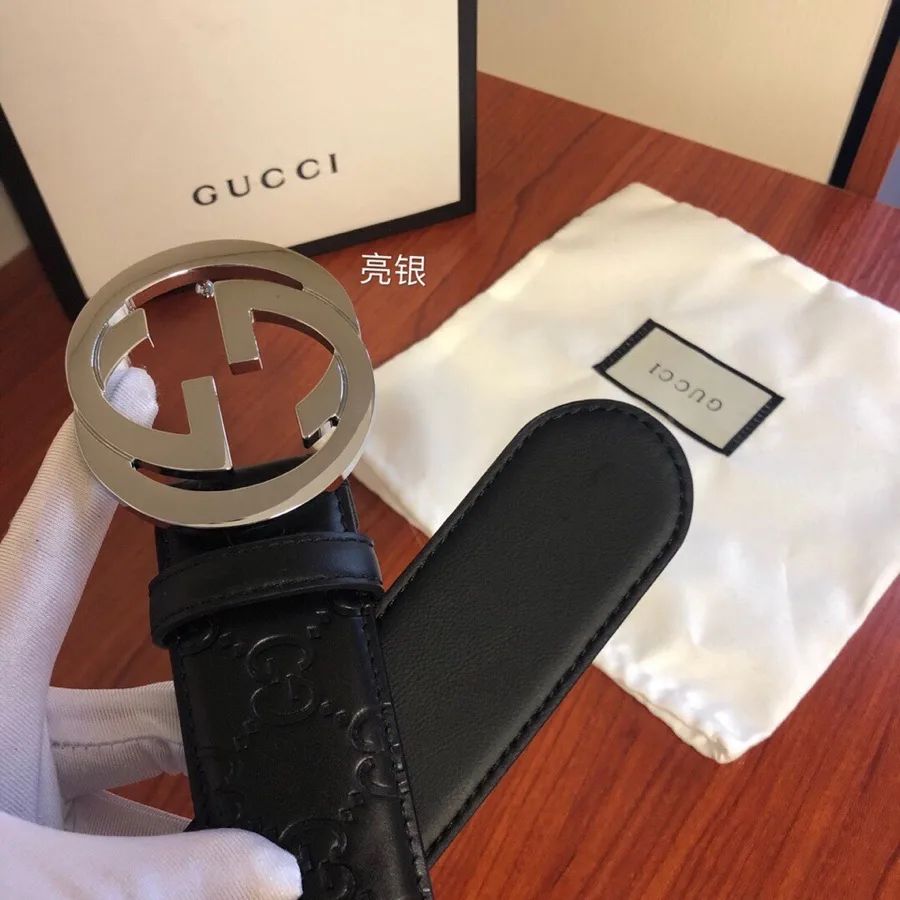
The buckle does not shrink with the strap
Across the line the hardware stays close to the same size while the strap width changes, and on the numbers Gucci publishes the proportion is stark.
| Strap | Published buckle size | Buckle as a share of strap width |
|---|---|---|
| 1.5 in wide | 3 in × 2.4 in, also listed as 3.03 in × 2.36 in | About twice the strap width |
| 1 in slim | 2.4 in × 2 in, or 2.36 in × 1.57 in | More than twice the strap width |
| 0.8 in thin | 2.36 in × 1.85 in | Close to three times the strap width |
Read the third column rather than the second. On the wide belt the Double G reads as a plate set into the strap; on the thinnest strap the same family of buckle dominates the strap almost completely. Two belts with the same motif, photographed flat, can therefore read as a heavy statement piece and a delicate one.
Hardware finish is the other variable, and Gucci publishes a different one per version rather than standardising: gold-toned and light gold-toned on the classic versions, palladium-toned on others, antiqued brass with a shiny finish on some women’s styles, antique palladium on others, plus ruthenium and black resin on specific straps. The finish is a styling choice, not a hierarchy — and it changes the belt’s register more than the length does.
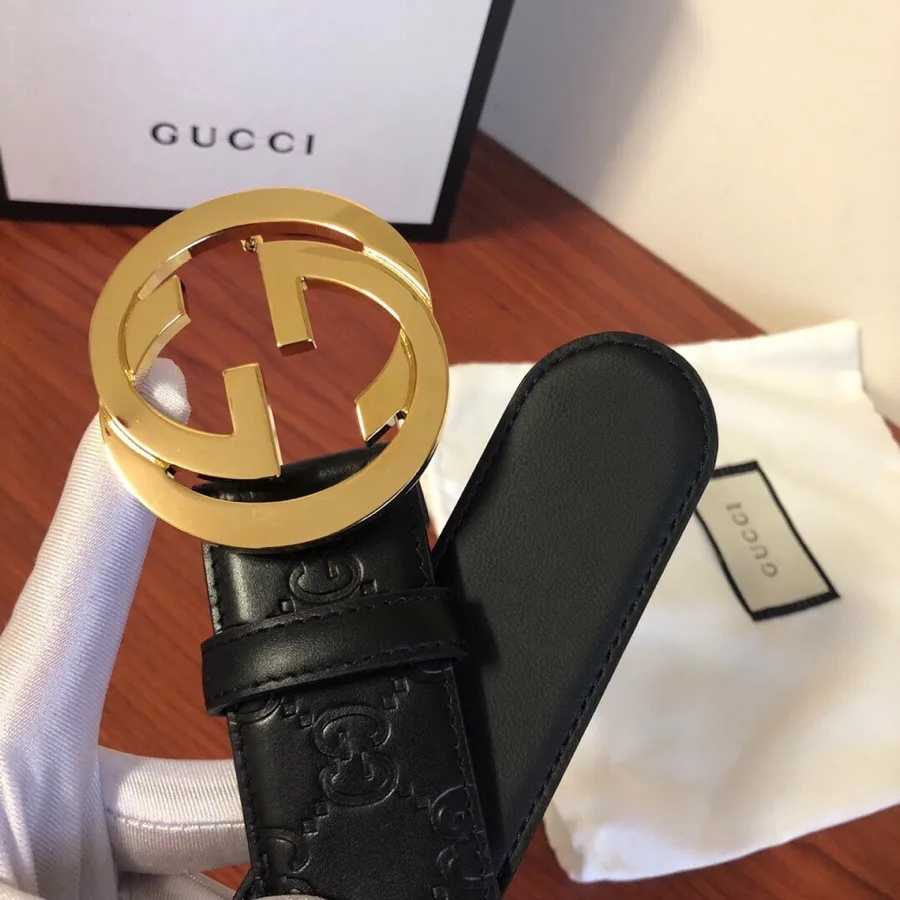
Where the Double G buckle actually comes from
Gucci’s own product copy is more precise than most summaries of it. The wide GG Marmont belt is described as “characterized by the Double G … Inspired by a buckle from the ’70s archives”, and another version of the belt is called “an archival reprisal from the ’70s collections”. The gold-toned hardware, the copy adds, is “imagined each season in new ways”.
The revival date is well attested: Alessandro Michele’s first collection showed in autumn 2015, and the reimagined double-G emblem reached the GG Marmont belt and bag line in 2016 (Rebag / Telegraph).
Where the interlocking Gs themselves begin is where accounts split. One frequently cited history credits Aldo Gucci with designing the motif in the 1960s and printing it on canvas thereafter (DesignRush); another dates the unveiling to 1933, when Aldo joined the business and designed an identifiable logo from his father’s initials. Both are published. The 1933 version is not what Gucci’s own belt copy says, because that copy describes the buckle shape rather than the logo’s first appearance.
So the belt carries three dates at once: a 1930s-or-1960s interlocking G, a 1970s buckle in the archive, and a 2015–2016 product. That is why it reads as both vintage and current depending on how close you are standing.
Leather, matelassé, canvas: three surfaces with three wear patterns
The line uses a handful of surfaces, and they behave differently over years.
- Matelassé leather — a quilted leather Gucci names on the GG Marmont line, where the motif decorates the belt “in Matelassé leather, topped with Double G hardware”. It holds a defined surface, and it creases where the belt is buckled, so a leather belt keeps the memory of the length it was worn at.
- Smooth and embossed calfskin — including heat-stamped leathers finished to a textured, boar-like effect, and heat-debossed Gucci Signature leather with a defined print and firm texture. These take the sharpest edges and show their first wear at the keeper loop.
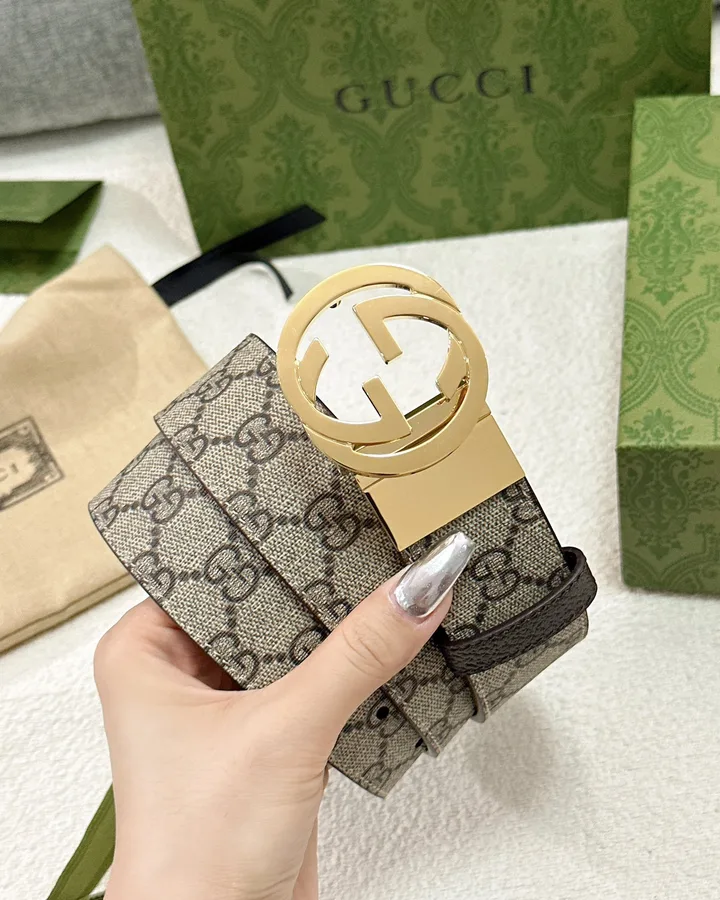
- GG Supreme canvas — a coated beige-and-ebony canvas with brown leather trim, the surface Gucci describes as having a low environmental impact. It stays flatter than leather, marks less at the crease, and shows edge wear first.
- The web stripe — the green-red-green band appears on quilted leather and canvas straps alike, running the length of the strap. On a thin strap it occupies a large share of the surface; on a wide strap it reads as a single line of colour.
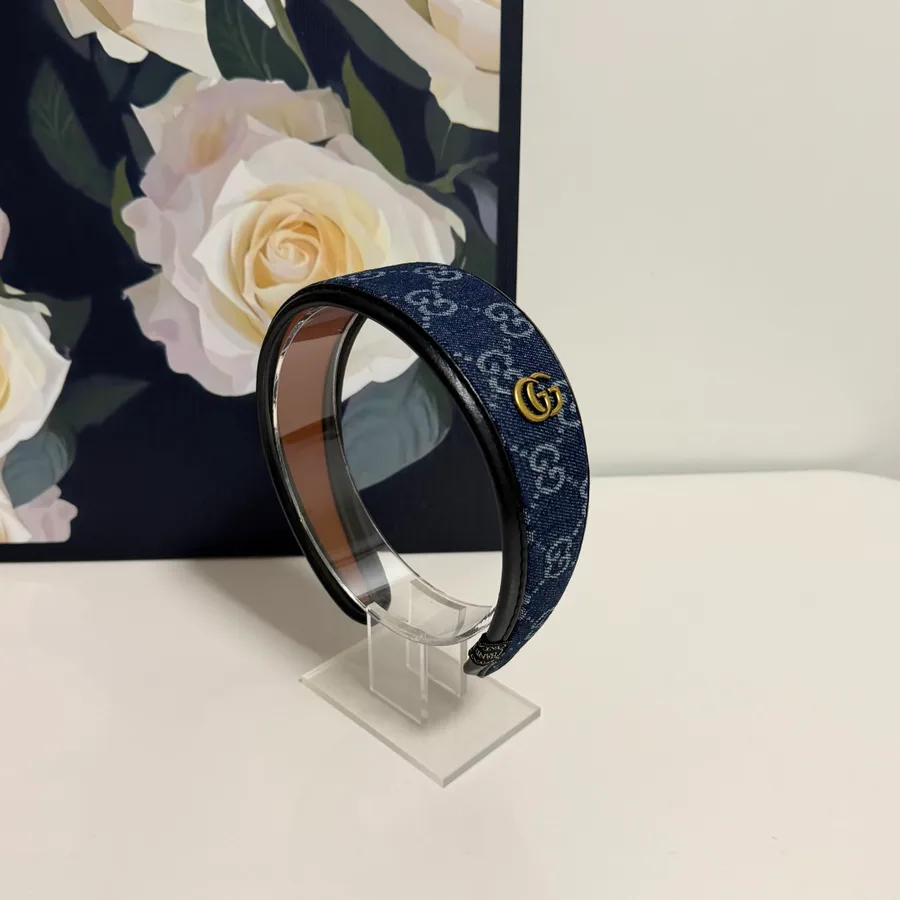
Checking a belt listing when you cannot try it on
Sizing a belt remotely is a measurement exercise, so here is what each kind of evidence actually settles.
| What to ask for | What it establishes | What it still cannot tell you |
|---|---|---|
| Strap laid flat with a tape, buckle edge to the third hole | The size, measured the way Gucci defines it | Whether you will prefer the belt at the hips or the waist |
| Full strap, all holes in frame | Whether it is a five-hole or a three-hole strap | How much adjustment is left after the third hole |
| Strap width with a ruler | Which of the four published widths you are looking at | How the surface will crease or wear over time |
| Buckle photographed beside the tape | The buckle’s size relative to the strap, and its finish | Whether the metal is a solid piece or a plated base |
| Close-up of the keeper loop and the edges | Where a used belt wears first | Anything about fit until you compare it to a belt you own |
| Stamp on the back of the strap | The size number, and any stamping | Nothing about body size on its own |
Two of those are worth insisting on. First, the length to a named hole — 90 cm to the third hole is checkable, while “size 90” on its own tells you what is stamped rather than what is measured. Second, the strap width in inches or centimetres, because the width tiers are what make two belts with the same buckle look like different products.
Photos cannot establish where a belt came from or whether a given colourway is currently offered. This page is a sizing and specification reference; the figures above describe how the sizing system is published, not what is available from anyone at a particular moment.
What to send when you ask about a Gucci belt
Start with the length, then the hole count, then the width, then the hardware finish. The single most useful number you can supply is the centimetre length of a belt you already wear well, measured from the buckle edge to your most-used hole.
Open a WhatsApp chat with that measurement, the width you want, the finish and a screenshot from the album, and we will send current photos of the piece with the strap laid flat and a tape across it, the hole count in frame, and the buckle measured against the strap. Browse the Belts Catalog for the current albums, or read the belt construction and failure points guide for how a strap is assembled and where it wears, the belt leather grades and construction guide for how the leather itself is chosen, and the Hermès belt size guide if you are weighing a system where buckle and strap are bought as two separate pieces.
Sources behind the Gucci belt figures on this page
- Gucci’s own belt size pages (gucci.com, US and international versions) — the women’s 65–120 cm ladder and the men’s 75–120 cm ladder with the US, IT, EU, UK and jeans columns, the two inch printings per step, and the measuring rule for Double G and standard buckle styles.
- Gucci belt product pages — the published widths of 1.5 in, 1.2 in, 1 in and 0.8 in, the buckle dimensions per tier (3 in × 2.4 in and 3.03 in × 2.36 in on the wide strap, down to 2.36 in × 1.85 in on the thinnest), the hardware finishes, and the “archival reprisal from the ’70s collections” description.
- A retailer size chart published alongside the same ladder — the same centimetres with a jeans column that does not match Gucci’s own, which is why jeans figures are shown as Gucci prints them here.
- Independent sizing references including Beltley and the Brandsvilla — the tier shorthand and the third-party reading of the size number that conflicts with Gucci’s own definition.
- Rebag, the Telegraph and Newsweek on the 2015–2016 revival, and DesignRush on the interlocking G motif.
Sources were checked on 3 October 2026. Where Gucci’s two regional pages print different inches for the same centimetres, both are described above. The strap widths published here also feed the generated Luxury Bag Size Index, which keeps belt widths, bag dimensions and shoe lengths in one table with a source page per row.
Frequently asked questions about Gucci belt sizes
- What does the size number on a Gucci belt mean?
- It is the strap length in centimetres to the third hole. Gucci's own size page states it two ways: for Double G styles, measure from the outer edge of the buckle to the third hole; for standard buckle belts, measure from the start of the strap to the third hole. Either way the number describes the strap, not the body, so it always reads longer than the waist it fits.
- How many holes does a Gucci belt have?
- Not always five. Gucci's own guidance notes that some belts come with five standard holes and others with three, which is why the measuring instruction says third hole rather than middle hole. On a three-hole strap the third hole is the end of the adjustment range rather than the centre of it, so ask which strap a listing has before converting a measurement.
- How do I find my Gucci belt size without trying one on?
- Measure a belt you already wear well: lay it flat and measure in centimetres from the buckle edge to the hole you use most. That figure is the size to look for. If you are between sizes, go up — extra holes can be added, but leather cannot be stretched. Gucci's own advice is to take one size smaller than your hip fit if you intend to wear the belt at the waist.
- Why does the same Gucci size show different numbers in different charts?
- Because there are two charts. The women's ladder runs 65–120 cm and prints US 28 against the 90 cm strap; the men's ladder runs 75–120 cm and prints US 32 against the same 90 cm. A third-party size table quoting 90 cm as a 32-inch waist is reproducing the men's row, which is why those tables and the women's chart appear to disagree.
- What widths do Gucci belts come in?
- Gucci's product pages print widths in inches: 1.5 in on the wide GG Marmont and GG Supreme belts (about 3.8 cm), 1.2 in on the women's GG Marmont thin (about 3 cm), 1 in on the slim men's strap (about 2.5 cm) and 0.8 in on the thinnest women's strap (about 2 cm). The familiar shorthand of 4 cm, 3 cm and 2 cm is those inch figures rounded to metric.
- Where does the Double G buckle come from?
- Gucci's own product copy calls the Double G an archival reprisal from the 1970s collections and describes the buckle as inspired by a buckle from the '70s archives; Alessandro Michele revived the double-G emblem in 2016, after first showing a collection in autumn 2015. Third-party accounts of the interlocking Gs themselves split between a 1933 dating and the 1960s.