Catalog note: Album entries can change. Use the live album link and WhatsApp to confirm the current option before ordering.
The LOEWE Puzzle is sold in four core sizes and LOEWE publishes the width first: 17.5 cm for the Mini, 24 cm for the Small, 29 cm for the Medium and 36.5 cm for the Large. Each step up roughly doubles the internal volume — about 1.6, 4.2, 7.9 and 16.0 litres — while the adjustable strap drop gets shorter, from 54.5–68.5 cm on the Mini to 40–58 cm on the Small.
The LOEWE Puzzle comes in four core sizes, and the width is the figure LOEWE prints first: 17.5 cm for the Mini, 24 cm for the Small, 29 cm for the Medium and 36.5 cm for the Large. Those four numbers answer most of the size questions buyers actually ask, provided you know which construction the size word is attached to.
LOEWE’s product pages give the full three-dimensional figure for each tier. The Mini measures 17.5 × 12.5 × 7.5 cm, or 6.9 × 4.9 × 3 inches. The Small measures 24 × 16.5 × 10.5 cm, or 9.4 × 6.5 × 4.1 inches. The Medium measures 29 × 19.5 × 14 cm, or 11.4 × 7.7 × 5.5 inches. The Large measures 36.5 × 23 × 19 cm, or 14.4 × 9.1 × 7.5 inches. Multiplying the three figures gives a workable internal volume: about 1.6 litres for the Mini, 4.2 for the Small, 7.9 for the Medium and 16.0 for the Large. The steps are not even. Width grows by 6.5 cm, then 5 cm, then 7.5 cm, while height grows by 4, 3 and 3.5 cm — which is why the Medium reads as a deeper bag rather than a much taller one, and why the Large is the only tier that changes category rather than degree.
Four tiers, measured on the same axes
Every dimension below is the one LOEWE publishes for the style, converted to inches at the same ratio the house prints. Volume is arithmetic on those three figures, not a capacity claim: a soft bag does not fill its own cuboid, and the Puzzle’s folded base takes a slice off the bottom.
| Tier | Width | Height | Depth | Width (in) | Height (in) | Depth (in) | Cuboid volume |
|---|---|---|---|---|---|---|---|
| Mini | 17.5 cm | 12.5 cm | 7.5 cm | 6.9 in | 4.9 in | 3 in | ≈ 1.6 L |
| Small | 24 cm | 16.5 cm | 10.5 cm | 9.4 in | 6.5 in | 4.1 in | ≈ 4.2 L |
| Medium | 29 cm | 19.5 cm | 14 cm | 11.4 in | 7.7 in | 5.5 in | ≈ 7.9 L |
| Large | 36.5 cm | 23 cm | 19 cm | 14.4 in | 9.1 in | 7.5 in | ≈ 16.0 L |
Two things follow from the table. The first is that the jump from Small to Medium is 5 cm of width, 3 cm of height and 3.5 cm of depth — a 1.9× volume increase delivered mostly through depth, which is the dimension you notice when the bag is under your arm. The second is that the Large is not a scaled-up Medium in any useful sense: it is 7.5 cm wider, 3.5 cm taller and 5 cm deeper, and its handle drop changes with it.
What LOEWE itself says each tier holds
The house attaches a use case to each size rather than a litre figure. The Mini is described as the size for the essentials, fitting most phones and a plain cardholder. The Small is the everyday size, described as fitting all mobile phones, a large wallet and a sunglasses case. The Medium is described as the more spacious tier, fitting a water bottle and the rest of a daily carry. Those three sentences are the most reliable capacity statement LOEWE publishes, because they are the only ones written against the bag rather than against a tape measure.
Independent try-on reporting fills the gap between the sentences. A retailer’s sizing guide, built with owners of each size, reports that the Small takes an 11-inch tablet, a phone, a notebook and a water bottle, and that the Medium takes the same tablet plus a water bottle and a scarf but will not comfortably close over a 13-inch laptop. The disagreement worth noting is that the Medium is only 5 cm wider than the Small — the laptop does not fit because of the bag’s 29 cm width and its zip opening, not because of its depth.
The smallest bag carries the longest strap
Strap geometry runs the opposite way to size. LOEWE publishes an adjustable strap of 108.5–137 cm on the Mini, with a drop of 54.5–68.5 cm and a handle drop of just 4 cm. The Small carries 80.5–115.5 cm with a 40–58 cm drop and a 7 cm handle drop. The Large carries 80.5–120.5 cm with a 40–60 cm drop and a 12 cm handle drop. A retailer’s guide puts the Medium at 79.5–119.5 cm with a 9 cm handle drop. The drop is not an independent measurement: in LOEWE’s own figures it is half the strap length, rounded. A 137 cm strap gives a 68.5 cm drop, a 115.5 cm strap gives 58 cm, and a 120.5 cm strap gives 60 cm. That makes the strap figure and the drop figure one fact printed twice, and it means the adjustment range is what actually separates the tiers — 28.5 cm on the Mini against 35 cm on the Small.
| Tier | Strap length | Strap drop | Handle drop | Published weight |
|---|---|---|---|---|
| Mini | 108.5–137 cm | 54.5–68.5 cm | 4 cm | 0.24 kg |
| Small | 80.5–115.5 cm | 40–58 cm | 7 cm | 0.52–0.66 kg |
| Medium | 79.5–119.5 cm | not published in the same block | 9 cm | 0.752 kg |
| Large | 80.5–120.5 cm | 40–60 cm | 12 cm | 1.1 kg |
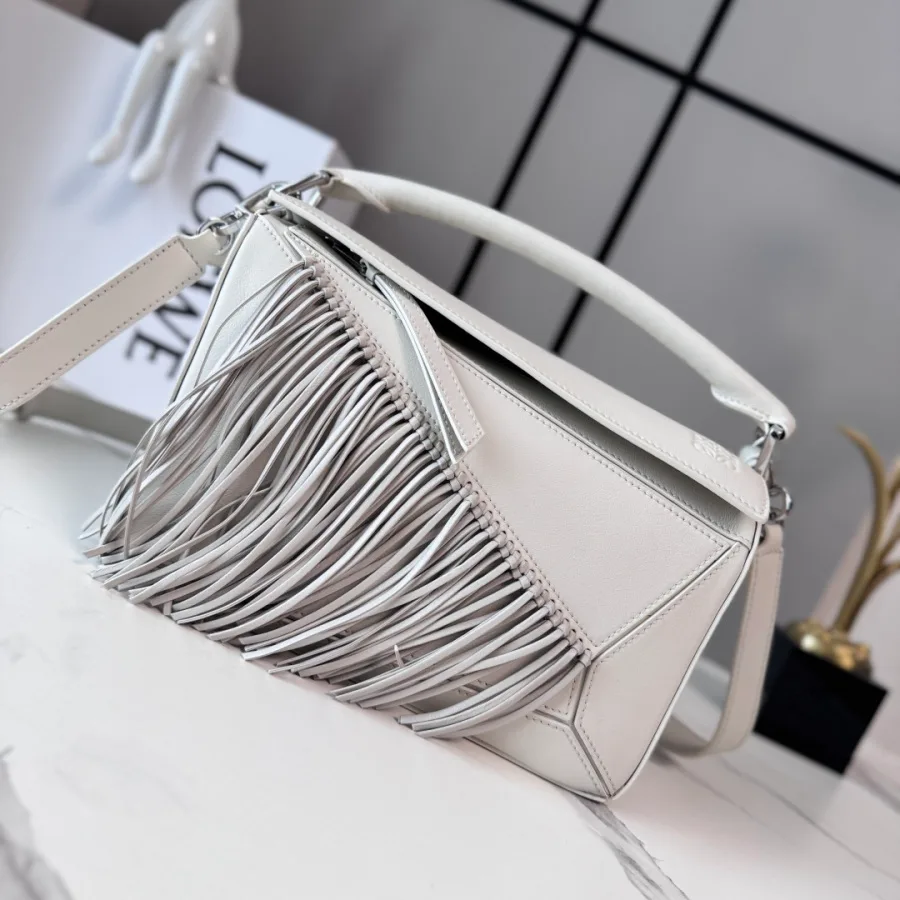
Read the drop column as a wearer’s instruction. A 68.5 cm maximum drop on the Mini puts the bag at hip level on most adults, which is where a crossbody strap is supposed to sit; the Small tops out at 58 cm, which lands higher and is why taller wearers often report the Small as a shoulder bag rather than a crossbody. The handle drop tells the other half of the story: 4 cm is a finger hold, 7 cm is a hand hold through the crook of the palm, 9 cm clears a wrist, and 12 cm is the first figure in the family that clears a coat sleeve.
Why an 11-inch tablet fits a 24 cm bag
The arithmetic that decides tablet fit is the diagonal, not the width. An 11-inch iPad Pro measures 24.97 × 17.75 cm, so its long edge is 0.97 cm longer than the Small’s 24 cm face and it cannot sit flat against the back panel. The Small’s face diagonal — the corner-to-corner distance across 24 × 16.5 cm — is 29.12 cm, which is still short of the tablet’s 30.64 cm face diagonal. What makes it work is depth: adding the bag’s 10.5 cm gives a three-dimensional diagonal of 30.96 cm, a margin of roughly 3 mm over the tablet’s 30.64 cm. The same face diagonal runs 21.51 cm on the Mini, 34.95 cm on the Medium and 43.14 cm on the Large, so the pattern is easy to apply to whatever tablet or sleeve you already carry.
That 3 mm is the whole answer, and it explains the contradictory reports. The tablet goes in corner-first, at an angle, and it stays at an angle; the bag closes because the leather gives, but the tablet is never flat. The same calculation on the Medium returns a 37.65 cm body diagonal against a 13-inch laptop’s 37.24 cm — a margin of 4 mm — which is technically inside and practically unusable, because a laptop is rigid, the zip opening is only 29 cm wide, and nothing about a 4 mm margin survives a bag being carried. Use the diagonal to rule sizes out, not to promise a fit.
The size word covers more than one bag
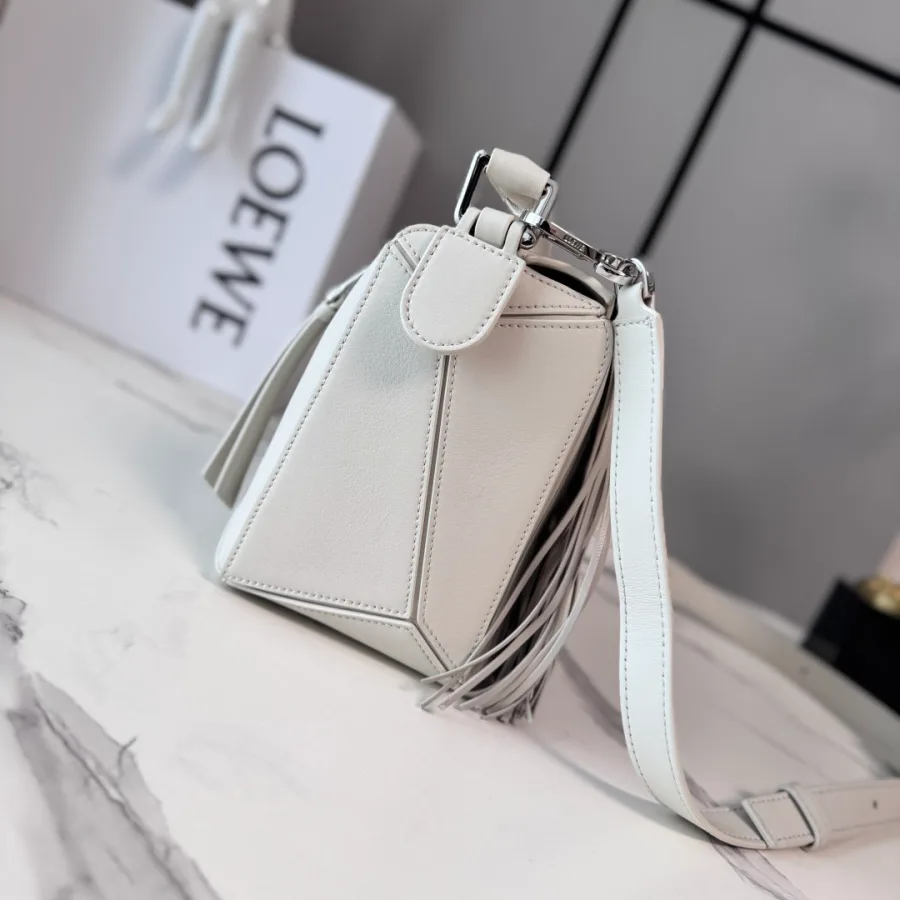
“Mini” is not one bag. The classic Puzzle Mini is 17.5 × 12.5 × 7.5 cm; the Puzzle Edge Mini is 18 × 12.5 × 8 cm. That is 5 mm more width and 5 mm more depth for the same word, and LOEWE states the construction difference plainly: the Edge is defined by overlapped panels with single stitch lines, where the classic is built from panels joined along visible seams. The face of an Edge reads flatter because the seam is folded under rather than stitched across the surface.
The family has grown past those two. The Featherlight line is cut in nappa lambskin and LOEWE describes it as the lightest iteration of the cuboid, with a longer shoulder-carry handle on the medium. The Puzzle Fold tote is a different object again: it is designed to fold flat, and its own published figures — a medium at 25.5 cm wide, 31.5 cm tall and 14.5 cm deep with a 27 cm handle drop and a 0.43 kg weight, and a large horizontal at 37 × 33 × 14.5 cm and 0.7 kg — do not correspond to any of the four numbered tiers.
Anyone shopping by the word “Puzzle” is therefore choosing between at least four structures. The size word narrows the field; the construction word decides the dimensions.
The Mini’s strap changed, and both numbers are live
Older reference material describes the Mini’s strap as a fixed 115 cm. Current LOEWE product blocks describe an adjustable 108.5–137 cm strap with a 54.5–68.5 cm drop. Both are correct for the piece they describe, and the difference is not cosmetic: a fixed 115 cm strap gives one drop, while the adjustable version adds 28.5 cm of range, which is the difference between a bag that hangs at the hip and one that can be shortened to sit above it.
The same drift appears in weights. The Small is published at 0.52 kg on some product blocks and 0.66 kg on others, and the Large at 1.1 kg on one listing against 1.3 kg on another carrying a different model ID. The pattern is material, not error: classic calfskin, grained calfskin and suede-faced versions share dimensions and not mass. When a listing quotes a weight, the leather in the same listing is the context that makes it meaningful.
Reading a listing: four figures and two words
A Puzzle listing can be checked against the published record without handling the bag. The four figures are width, height and depth in the order the house prints them, plus the strap length; the two words are the construction and the leather. A listing that gives 24 × 10.5 × 16 cm has given width, depth and height out of order — the same bag as 24 × 16.5 × 10.5 cm, but only if you notice the swap before comparing it with a chart.
The second check is the size word against the centimetres. “Small” should come with 24 cm, “Medium” with 29 cm, “Large” with 36.5 cm and “Mini” with either 17.5 cm or 18 cm depending on construction. A listing that pairs “Mini” with 24 cm is describing the Small under another name, which happens often enough on resale platforms that the centimetre figure is the safer identifier.
What a catalog photo settles
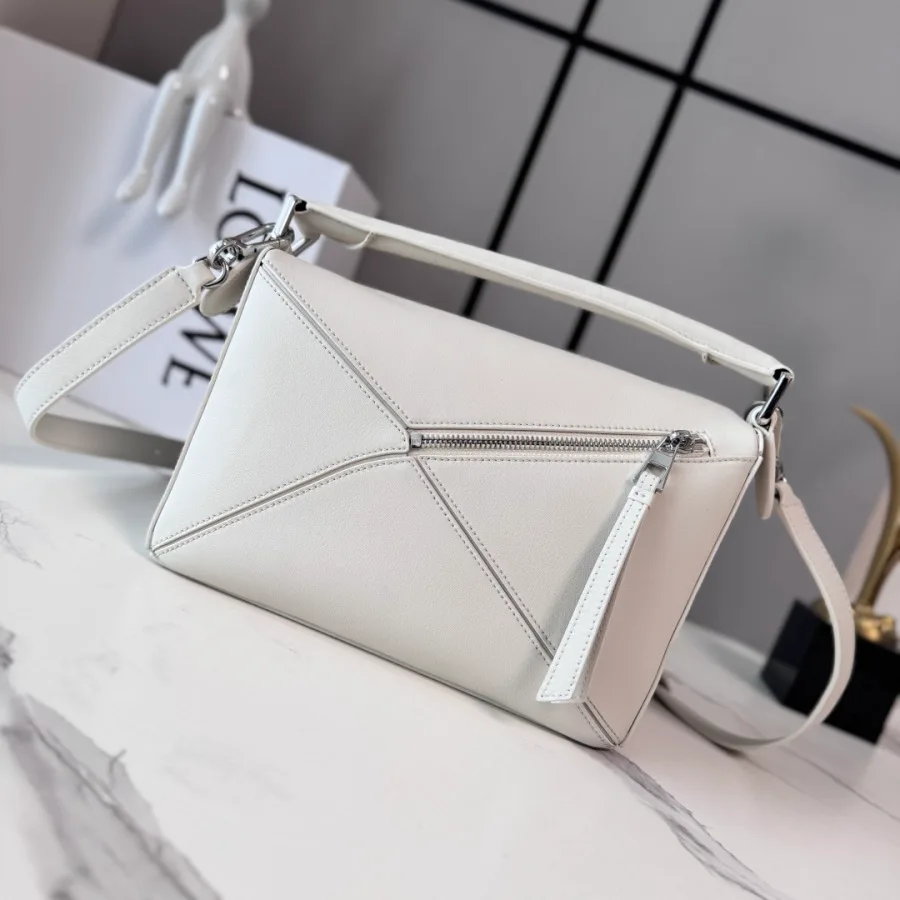
A photograph settles the panel layout, which is the fastest way to tell the constructions apart: a classic Puzzle shows seams crossing the face in a patchwork of triangles and rectangles, while an Edge shows overlapped panels with a single line of stitching and a flatter surface. It also settles the strap hardware — a detachable clip on both ends, an adjustable slider, and a leather tab on the zip.
What no photograph carries is scale. Without a ruler in frame, 17.5 cm and 24 cm look nearly identical, and a bag photographed on a model tells you more about the model than about the bag. The useful additional frames are the interior with a phone or a wallet in place, the strap laid out against a tape measure, and the zip opening photographed end to end. Those three answer the question the dimensions raise: whether the thing you carry every day goes in flat or at an angle.
What to send with a Puzzle size question
Send the width in centimetres first, because it identifies the tier faster than the size word. Add the construction — classic, Edge, Featherlight or Fold — because the same word covers different dimensions. Then the strap length you want, measured on a bag you already wear at the height you like it, and the longest rigid object you plan to carry with its length and width. Four lines of text settle a size question that photographs cannot.
Browse the bags catalog or send those four lines on WhatsApp. For the same exercise at other houses, the Bottega Veneta Jodie size guide works through a rename that shifted every size word, the Louis Vuitton Neverfull size guide compares three tiers on one measurement grid, the Celine Triomphe size guide separates two tiers that share a silhouette, and the Prada Re-Edition guide shows what happens when one name covers three sizes. The shoulder bag hub and the crossbody bag hub group the same shapes by how they are carried.
Where these figures were read, and when
Everything above is a reading of a published page, checked in October 2026. Where two pages attach different values to the same word, both readings are printed rather than averaged.
- LOEWE product pages, women’s Puzzle, checked October 2026: the “what can I fit” block giving the Mini at 17.5 × 12.5 × 7.5 cm, the Small at 24 × 16.5 × 10.5 cm and the Medium at 29 × 19.5 × 14 cm, each with the use case the house attaches to it
- The LOEWE Small Puzzle bag product block, model A510S21XDJ, checked October 2026: strap length 80.5–115.5 cm, strap drop 40–58 cm, handle drop 7 cm, weight 0.66 kg, height 16.5 cm, width 24 cm, depth 10.5 cm
- The LOEWE Large Puzzle bag product block, checked October 2026: strap length 80.5–120.5 cm, strap drop 40–60 cm, handle drop 12 cm, weight 1.1 kg, height 23 cm, width 36.5 cm, depth 19 cm, made in Spain
- The LOEWE Mini Puzzle bag product block, model A510P88X26, checked October 2026: strap length 108.5–137 cm, strap drop 54.5–68.5 cm, handle drop 4 cm, weight 0.24 kg, height 12.5 cm, width 18 cm, depth 8 cm
- LOEWE’s description of the Puzzle Edge, checked October 2026: “It differs to the classic construction in its overlapped panels with single stitch lines”, with the Edge Mini given at 18 × 12.5 × 8 cm
- LOEWE’s Puzzle Fold tote pages, checked October 2026: the medium at 25.5 cm wide, 31.5 cm tall and 14.5 cm deep with a 27 cm handle drop and 0.43 kg, and the large horizontal at 37 × 33 × 14.5 cm and 0.7 kg
- A retailer’s LOEWE Puzzle sizing guide, published 2021, read October 2026: the Mini at 115 cm strap length, 4 cm handle drop and 0.24 kg; the Small at 80.5–115.5 cm, 7 cm handle drop and 0.5 kg; the Medium at 79.5–119.5 cm, 9 cm handle drop, 0.752 kg and 29 × 19.5 × 14 cm; and the try-on notes on what each size takes
- Apple’s published specifications for the 11-inch iPad Pro (M4), read October 2026: 249.7 mm × 177.5 mm × 5.3 mm, used for the diagonal arithmetic above
Frequently asked questions about LOEWE Puzzle sizes
- What are the LOEWE Puzzle sizes in cm?
- LOEWE lists four core tiers: Mini at 17.5 × 12.5 × 7.5 cm, Small at 24 × 16.5 × 10.5 cm, Medium at 29 × 19.5 × 14 cm and Large at 36.5 × 23 × 19 cm. The width is the figure printed first, and it is the one buyers use as shorthand — a listing that says 24 cm is describing the Small.
- Is the Small Puzzle big enough for an iPad?
- An 11-inch iPad Pro measures 24.97 × 17.75 cm, so it is 0.97 cm longer than the Small's 24 cm face and cannot lie flat. It fits because the bag is 10.5 cm deep: the Small's three-dimensional diagonal is 30.96 cm against the tablet's 30.64 cm, a margin of about 3 mm. It goes in corner-first, and nothing else rigid goes in with it.
- What is the difference between the Puzzle and the Puzzle Edge?
- The construction. The classic Puzzle is built from leather panels joined along visible seams in a patchwork; the Puzzle Edge uses overlapped panels with single stitch lines, so the face reads flatter. The Edge Mini is also 5 mm wider and 5 mm deeper than the classic Mini — 18 × 12.5 × 8 cm against 17.5 × 12.5 × 7.5 cm — which matters when you are buying an insert or a bag organiser cut to size.
- How long is the Puzzle strap, and how far does it drop?
- LOEWE publishes an adjustable strap on the core sizes: 108.5–137 cm on the Mini with a 54.5–68.5 cm drop, 80.5–115.5 cm on the Small with a 40–58 cm drop, and 80.5–120.5 cm on the Large with a 40–60 cm drop. The Medium's strap is listed by a retailer's own guide at 79.5–119.5 cm. Earlier Minis shipped with a fixed strap of about 115 cm, so both figures are still in circulation.
- How much does a LOEWE Puzzle weigh?
- Published weights run from about 0.24 kg on the Mini, through 0.52–0.66 kg on the Small and 0.752 kg on the Medium, to 1.1 kg on the Large. The spread inside a single size comes from the leather: a smooth classic calfskin and a grained or suede-faced version of the same dimensions are not the same weight.
- Which Puzzle size is the best crossbody?
- In published numbers, the Mini has the longest strap drop at 54.5–68.5 cm, against 40–58 cm on the Small and 40–60 cm on the Large. The Mini therefore hangs lowest and works crossbody on taller wearers, while its 4 cm handle drop makes it a hand or wrist carry rather than a shoulder bag without the strap.