Catalog note: Album entries can change. Use the live album link and WhatsApp to confirm the current option before ordering.
Gucci publishes two different sets of numbers for the same hoodie. Its clothing size chart gives body measurements — a men's M is an Italian 48 with a 98 cm chest — while the page for the individual style gives finished-garment figures, such as a 60.5 cm chest and a 67.5 cm length on that same M. The letter sizes only exist between Italian 42 and 56: Italian 40, 58, 60, 62 and 64 carry no letter on Gucci's own grid, and an Italian 48 is a men's M but a women's XXL. The style page decides the fit, and a flat chest measurement of a sweatshirt you already own is the number worth comparing to it.
Gucci publishes two different sets of numbers for the same hoodie. Its clothing size chart gives body measurements — a men’s M is an Italian 48 with a 98 cm chest — while the page for the style itself gives finished-garment figures, such as a 60.5 cm chest and a 67.5 cm length on that same M. Neither figure is wrong; they measure different things.
Every number in this guide is attached to the page that prints it: Gucci’s own clothing size chart, the product-detail lines on five men’s sweatshirt and hooded sweatshirt pages, four women’s styles including knitwear and a cardigan, and the size grids that Gucci’s own category pages publish. Styles were checked on 28 September 2026, and the style numbers are given so that any figure can be re-read at source.
Two sets of numbers sit on one product page
Open any Gucci sweatshirt page and the measurements appear in two places that look similar and are not. Under the product details there is a single line quoting length, chest, shoulder and sleeve figures against one named size — the finished garment as Gucci measures it. Further down, behind “View size guide”, the same page prints the house chart, which Gucci describes as displaying sizes based on body measurements, with shoulders and a chest given for each letter and each Italian number.
The men’s half of that chart, exactly as Gucci prints it:
| Gucci size | US | IT | Shoulders | Chest |
|---|---|---|---|---|
| — | 30 | 40 | 43 cm | 82 cm |
| XXS | 32 | 42 | 44 cm | 86 cm |
| XS | 34 | 44 | 45 cm | 90 cm |
| S | 36 | 46 | 46 cm | 94 cm |
| M | 38 | 48 | 47 cm | 98 cm |
| L | 40 | 50 | 48 cm | 102 cm |
| XL | 42 | 52 | 49 cm | 106 cm |
| XXL | 44 | 54 | 50 cm | 110 cm |
| XXXL | 46 | 56 | 51 cm | 114 cm |
| — | 48 | 58 | 52 cm | 118 cm |
| — | 50 | 60 | 53 cm | 122 cm |
A men’s M on that table is an Italian 48, a US 38, with a 47 cm shoulder and a 98 cm chest. Now the same letter as it appears under the product details of a brushed cotton jersey sweatshirt, style 795510 XJHN8 1043: length 67.5 cm, shoulder 61 cm, chest 60.5 cm, sleeve 64 cm, all against a size M. The chest figure has fallen from 98 cm to 60.5 cm and the shoulder has grown from 47 cm to 61 cm, on one page, for one size, in the same letter. The explanation is that the chart is describing the body the garment is cut for, and the product line is describing the garment itself, measured flat. Gucci never says which is which in the product details — the words “body” and “garment” do not appear there — which is why the same two numbers, read the wrong way round, will send a buyer two sizes off in either direction.
The same word, two quantities
The clearest proof that the two figures measure different things is on Gucci’s women’s knitwear, where the field is not called chest at all. A cotton polo top with Gucci intarsia, style 815905 XKELU 4137, lists its measurements as length 59 cm, shoulder 44 cm, half waist/chest 54 cm and sleeve length 57 cm, all against a size S. Half waist/chest is the name for a flat measurement across the front of the garment, so 54 cm across the front is roughly 108 cm around — which is what a woman whose chart chest sits near 86 cm should expect from a garment with that much room in it.
| Style | Field names as published | The same figure as a chart value |
|---|---|---|
| 795510 XJHN8 1043, men’s sweatshirt, M | Chest 60.5 cm | men’s M chart chest 98 cm |
| 784413 XJG5 99074, men’s sweatshirt, M | Chest 60 cm | men’s M chart chest 98 cm |
| 795419 XJGQH 1056, men’s hooded, S | Chest 63 cm | men’s S chart chest 94 cm |
| 815905 XKELU 4137, women’s polo, S | Half waist/chest 54 cm | women’s S chart chest 86 cm |
| 818588 XKENL 3683, women’s cardigan, S | Half waist/chest 19.7 in (about 50 cm) | women’s S chart chest 86 cm |
Read across the middle column and the inconsistency is visible on Gucci’s own site: two men’s sweatshirts in the same letter both quote a chest of about 60 cm, a hooded men’s style quotes 63 cm at a smaller letter, and the women’s knitwear calls the same position half waist/chest. Whoever treats those as one comparable quantity will conclude that a men’s M is narrower than a men’s S, which is not what the pages mean. In practice: the chart converts your body into a letter, and the product line tells you how the finished piece differs from other pieces in the same letter.
Four published field names, and no two of them defined
Gucci’s per-style measurement lines use at least four labels for positions buyers assume are fixed. Men’s 795510 quotes a “Shoulder”; men’s 795419 quotes a “Shoulder drop”; the women’s knitwear quotes “Half waist/chest”; the women’s denim jacket 794953 XDC0F 4011, a regular-fit piece anchored to an Italian 40 rather than to a letter, quotes “Shoulder drop 49 cm” next to “Chest 54.5 cm”. There is no page on the site that defines those terms, and the figures behind them move a long way: the men’s oversized hooded style reports a shoulder drop of 71.5 cm at a size S, while the women’s oversized hooded style reports 59 cm at a size S.
| Style number | Garment | Fit word published on the page | Figures, with the size they are quoted against |
|---|---|---|---|
| 795419 XJGQH 1056 | men’s cotton jersey hooded sweatshirt | Oversize fit | Shoulder drop 71.5 cm, chest 63 cm, sleeve 54 cm, length 70 cm — size S |
| 788090 XJGJ7 1043 | men’s cotton jersey hooded sweatshirt | Regular fit | Chest 63 cm, sleeve 95 cm, length 70 cm — size S |
| 795510 XJHN8 1043 | men’s brushed cotton jersey sweatshirt | not stated | Length 67.5 cm, shoulder 61 cm, chest 60.5 cm, sleeve 62 cm — size M |
| 795510 XJG3O 1056 | same style, Web banner print | not stated | same four figures, size M; model 184 cm wearing M |
| 784413 XJG5 99074 | men’s cotton jersey sweatshirt with print | Regular fit | Length 74 cm, shoulder 54 cm, chest 60 cm, sleeve 64.5 cm — size M |
| 798544 XJGSK 1192 | women’s viscose jersey hooded sweatshirt | Oversize fit | Shoulder drop 23.2 in, chest 23.6 in, sleeve 55 cm, length 52.5 cm — size S (IT) |
| 469250 XJCCG 9230 | women’s oversize sweatshirt with Gucci logo | Oversize fit | Length 63 cm — size small |
| 469250 XJBUE 5774 | same style, lamb patch colourway | Oversize fit | Length 24.8 in — size small |
Two hooded sweatshirts in the same season, both quoted at a size S, both with a 63 cm chest and a 70 cm length, and sleeve figures of 54 cm and 95 cm. One of those two numbers is measured from the shoulder seam and one from somewhere else entirely — most likely the centre back of the neck, which is how a dropped-shoulder sleeve is measured when the seam itself sits off the shoulder. Nothing on either page states the starting point, so the only safe use of a published sleeve figure is as a comparison against another figure taken the same way, which in practice means against the same style in another size.
Centimetres on one page, inches on another, same garment
Gucci’s regional pages do not agree on units, even for the same style number. The women’s viscose jersey hooded sweatshirt 798544 XJGSK 1192 is listed on the US page with a shoulder drop of 23.2 inches and a chest of 23.6 inches at a size S (IT). The same style’s figures circulate in centimetres as 59 cm and 60 cm, and the conversion is exact: 23.2 inches is 58.9 cm and 23.6 inches is 59.9 cm. A buyer who lands on the inch version and reads “23.6” as a number to compare with a centimetre tape will be wrong by a factor of two and a half.
The same split runs inside a single style number in two colourways. The women’s oversize sweatshirt with Gucci logo, style 469250, quotes its length as 63 cm on one colourway page and as 24.8 inches on another — the same 63 cm, in the other unit, for a garment whose only difference is a patch. Neither page mentions the other, and both anchor the figure to a size small while stating that the model photographed is wearing a large.
The letter grid has holes in it
Gucci’s letters do not cover the full numeric ladder, and the two versions of the chart do not have the same top end. On the men’s shirts-and-tops table the letters run from XXS at Italian 42 to XXXL at Italian 56; Italian 40, 58 and 60 appear with a dash where a letter would sit. The copy of the same table embedded in product pages continues four rows further, to Italian 58, 60, 62 and 64 with chests of 118, 122, 126 and 130 cm, and those four rows also carry no letter. So a garment sold on the strength of an Italian number above 56 has no letter equivalent anywhere on Gucci’s site, and a buyer who needs a letter has to derive it. In other words, the top of the letter range and the top of the numeric range are describing different garments.
That matters because the two scales are sold side by side in the same category. The men’s tracksuits and sweatshirts grid on Gucci’s UK site offers size filters for Italian 44, 46, 48, 50 and 52, one garment each, next to filters for XXS through 4XL — a distribution of 19 at XXS, 55 at XS, 59 at S, 60 at M, 59 at L, 59 at XL, 54 at XXL, 46 at XXXL and 21 at 4XL. Two of those nine lettered sizes, XXXL and the separate 4XL, sit above the top row of the men’s chart, which stops at 56. Any hoodie in that part of the grid has to be sized from the product line rather than from the letter.
Italian 48 is a men’s M and a women’s XXL
The women’s half of Gucci’s chart is shorter than the men’s and does not use the same letters for the same numbers:
| Gucci size | US | IT | EU | UK/AU | JP | Shoulder | Chest |
|---|---|---|---|---|---|---|---|
| XXXS | — | 34 | 30 | 2 | 3 | 37 cm | 77 cm |
| XXS | 0 | 36 | 32 | 4 | 5 | 38 cm | 80 cm |
| XS | 2 | 38 | 34 | 6 | 7 | 39 cm | 83 cm |
| S | 4 | 40 | 36 | 8 | 9 | 40 cm | 86 cm |
| M | 6 | 42 | 38 | 10 | 11 | 41 cm | 89 cm |
| L | 8 | 44 | 40 | 12 | 13 | 42.5 cm | 93 cm |
| XL | 10 | 46 | 42 | 14 | 15 | 44 cm | 97 cm |
| XXL | 12 | 48 | 44 | 16 | 17 | 45.5 cm | 101 cm |
Italian 48 is a men’s M with a 98 cm chest and a women’s XXL with a 101 cm chest, three centimetres apart on the body figure and four letters apart on the label. The women’s ladder also has eight steps against the men’s eleven, and it stops at 48 where the men’s continues to 60 and beyond. Two consequences follow for anyone reading a listing: an Italian number quoted without the men’s or women’s side of the chart is unreadable, and a women’s size above Italian 48 has no row on Gucci’s own women’s chart at all — the women’s sweatshirt grid offers up to XXL, with the larger sizes thinning out to two garments out of ten. That second point matters more than it sounds: a women’s piece listed as an Italian 50 cannot be sized from Gucci’s published women’s table, only from the finished-garment figures on its own product page.
Building a size from a sweatshirt you already own
The chart answers only half the question, so the practical method uses a garment rather than a body. Take a hoodie or sweatshirt that fits the way you want, lay it flat, and take four figures: chest measured straight across the front from one underarm seam to the other, total length from the highest point of the shoulder down to the hem, sleeve length with the starting point noted, and shoulder width seam to seam. Write them down with the size on that garment’s own label next to them.
Then put those four figures beside the product line for the style being considered. If the chest spans match within a centimetre or so and the length matches, the letter matters much less than it appears to, because the finished measurements are what the garment does. If the style line quotes only some of the four — women’s 469250 gives a length and nothing else — ask for the missing ones rather than substituting a chart value, since the chart is a body target and the product line is the garment.
Two of the figures need a caveat. Sleeve length is comparable only when both figures start at the same place, and Gucci’s published examples start at different places, so where a sleeve is quoted as 95 cm against 54 cm for a similar garment, treat the number as unusable for cross-style comparison and ask for it measured from the shoulder seam. Shoulder width behaves the same way: 47 cm of the men’s chart, 54 cm on a regular-fit printed sweatshirt, 61 cm on a brushed sweatshirt with a dropped shoulder, and 71.5 cm named as a shoulder drop on an oversized hooded style are four different quantities wearing two similar words.
Where the photographs stop being useful
Photographs are the fastest way to establish what is being offered and the slowest way to establish what will fit. In the images below the garment itself carries the information: a fixed hood with a drawstring and a kangaroo pocket, a ribbed collar and cuffs, a logo printed or embroidered at the chest, and in one frame the back neckline where a label sits. None of that says anything about size. The letter lives on a woven label inside the back neckline, and in most catalogue photography it is either out of frame or unreadable even when it is in frame.
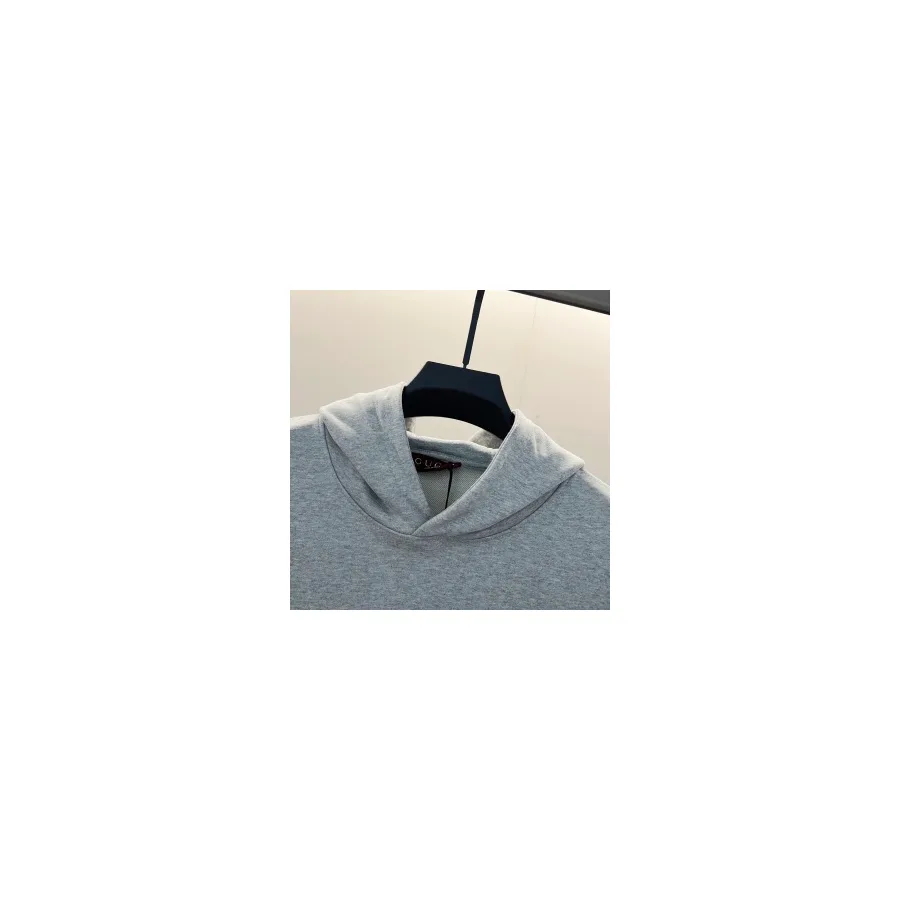
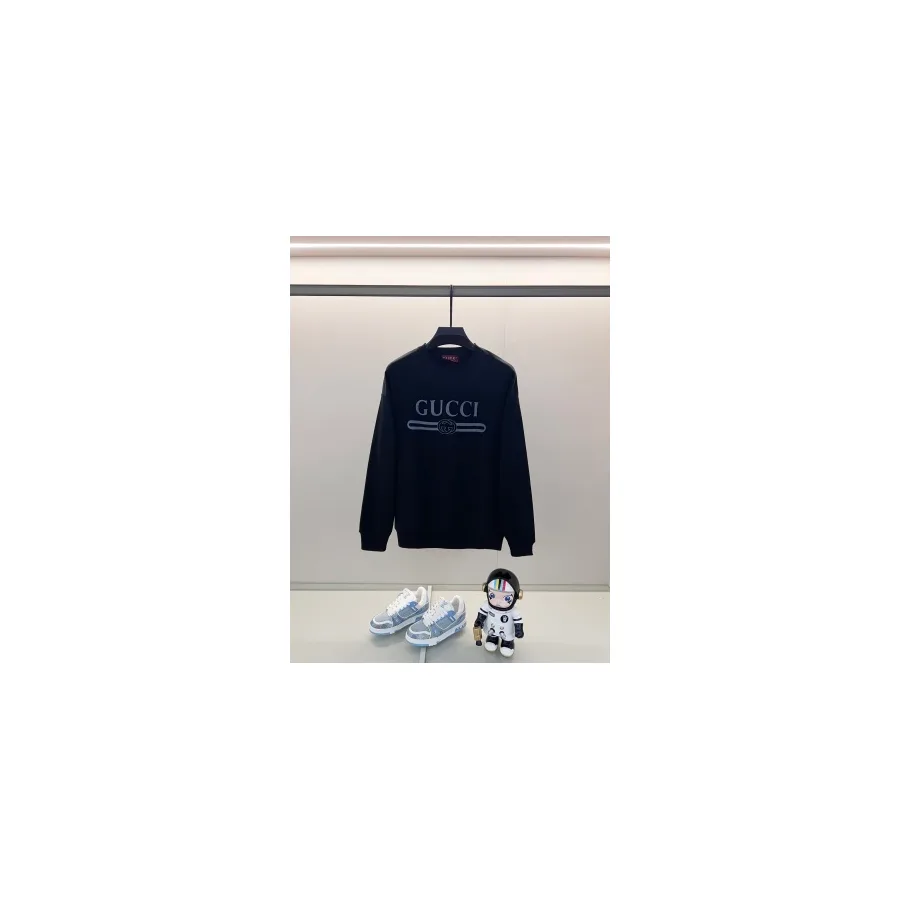
Album titles are marketing copy and are written to sell a piece, so the model name in a title is a weaker signal than the garment in the frame. Where a listing quotes a number, the useful follow-up is which quantity it is: a label size, a flat measurement, or a body measurement. On these pages the same garment can be described by an Italian number, a letter, a 60 cm flat figure and a 98 cm body figure, and only one of those is the letter on the label.
Three figures to put in your first message
A sizing question that gets settled in one reply carries the style number or the catalogue screenshot, the four flat measurements of a garment you already own that fits the way you want, and the letter or Italian number you normally take — kept apart rather than blended into one “size 48”. With those, the product line answers the chest and the length, and the chart only has to convert your body into a letter.
Browse the Clothing Catalog or send your figure on WhatsApp. Include the flat chest, length and sleeve measurement of a sweatshirt you own, and whether you want it close or roomy. The size tables and measurements quoted above are published references collected for research, not a statement about any particular piece in the catalog. For the same approach applied to another house with a numeric ladder, the Moncler jacket size guide converts a number 00 to 7 into body measurements; the Burberry trench coat size guide works through the UK, US and Italian columns on a coat; and the fabric quality guide covers what fibre content and weight mean on a jersey piece, which is what decides how much a hoodie relaxes after a few wears.
The Gucci pages behind every figure here
Every number above is attached to a page that publishes it. Styles and charts were checked on 28 September 2026; product pages change with each season, so a style that has sold through may no longer be live even though its measurements remain useful as a record of how Gucci sizes that family.
| Source | What it establishes |
|---|---|
| Gucci: clothing size chart | The men’s shirts-and-tops ladder (Italian 40 to 60, shoulders 43 to 53 cm, chests 82 to 122 cm, letters only from 42 to 56) and the women’s dresses-and-tops ladder (Italian 34 to 48) |
| Gucci: cotton jersey hooded sweatshirt 795419 XJGQH 1056 | An oversized hooded style with a shoulder drop of 71.5 cm, a chest of 63 cm and a sleeve of 54 cm at a size S, plus the product-page version of the chart running to Italian 64 |
| Gucci: brushed cotton jersey sweatshirt 795510 XJHN8 1043 | A crewneck quoting length 67.5 cm, shoulder 61 cm, chest 60.5 cm and sleeve 62 cm against a size M, beside a 98 cm chart chest for the same letter |
| Gucci: cotton jersey sweatshirt with print 784413 XJG5 99074 | A regular-fit style with a shoulder of 54 cm and a sleeve of 64.5 cm at a size M, against 61 cm and 62 cm on the brushed sweatshirt in the same letter |
| Gucci: viscose jersey hooded sweatshirt 798544 XJGSK 1192 | The same style published in inches (shoulder drop 23.2 in, chest 23.6 in) as the centimetre version of 59 cm and 60 cm |
| Jaguar Luxury Fashion: the same style in centimetres | A retailer republication of style 798544 in centimetres, confirming 59 cm shoulder drop, 60 cm chest, 55 cm sleeve and a 52.5 cm length at a size S (IT) |
| Gucci: oversize sweatshirt with Gucci logo 469250 XJCCG 9230 | A women’s style quoting length alone, 63 cm at a size small, with the model at 173 cm in a size large |
| Gucci: cotton polo top with Gucci intarsia 815905 XKELU 4137 | The “half waist/chest” field name, 54 cm at a size S, which identifies the per-style figures as flat measurements |
| Gucci: cashmere-silk cardigan 818588 XKENL 3683 | The same field published in inches, 19.7 in at a size S, on a cardigan listed with a 25.2 in length |
| Gucci: denim jacket with Gucci print 794953 XDC0F 4011 | A regular-fit piece anchored to Italian 40 rather than to a letter, with a shoulder drop of 49 cm and a chest of 54.5 cm |
| Gucci: men’s tracksuits and sweatshirts grid | The category size filter offering Italian 44 to 52 and XXS to 4XL side by side, with the per-size garment counts |
Frequent questions about Gucci hoodie and sweatshirt sizing
- Do Gucci hoodies run big?
- It depends on the style line, not on the letter. Gucci labels some hooded sweatshirts "Oversize fit" and others "Regular fit" on the product page, and prints finished-garment figures that differ between them. On one men's oversized hooded style the chest is given as 63 cm at a size S, while a regular-fit hooded style of the same season gives 63 cm at a size S as well but a 95 cm sleeve figure instead of 54 cm — because the two pages do not define the sleeve the same way. Read the fit word and the measurements for the exact style, and treat a blanket "runs big" or "true to size" answer as unverified.
- What is a Gucci size M in centimetres?
- On Gucci's men's shirts-and-tops chart a M is an Italian 48, with shoulders of 47 cm and a chest of 98 cm given as body measurements. On the women's dresses-and-tops chart the same letters run one step apart at most sizes: a women's M is an Italian 42 with a 89 cm chest. Those two figures are targets for the body, not the garment, so the finished hoodie will measure considerably wider than either number.
- Why do Gucci's own measurements differ between the size chart and the product page?
- Because they measure two different things. The chart on Gucci's clothing size page is described by the site itself as displaying sizes based on body measurements. The line in the product details, which quotes length, chest, shoulder and sleeve figures against one named size, is the finished garment. Using the body chart to imagine how the garment will drape, or using the garment figure as a body measurement, is where most sizing mistakes come from.
- What does "half waist/chest" mean on a Gucci garment?
- It is Gucci's own label for the flat measurement taken across the front of the garment, so it covers roughly half the circumference. The field name appears on women's knitwear and cardigan pages, where the same position is also quoted in inches: a cashmere-silk cardigan lists a half waist/chest of 19.7 inches at a size S, which is about 50 cm across the front. Where the men's sweatshirt pages use the plainer word "Chest" for a similar figure, the two are not interchangeable labels.
- Is an Italian 48 the same across men's and women's Gucci clothing?
- No. Italian 48 is a men's M with a 98 cm chest on the men's shirts-and-tops chart, and a women's XXL with a 101 cm chest on the dresses-and-tops chart. The women's chart also stops at Italian 48, while the men's ladder continues to Italian 60 and, on individual product pages, to Italian 64. A number quoted without the men's or women's side of the chart attached cannot be resolved.
- Which Gucci sweatshirt measurements should I ask for when buying remotely?
- Ask for four figures taken flat on the garment: chest measured pit to pit across the front, total length from the highest point of the shoulder to the hem, sleeve length with its starting point named, and shoulder width measured seam to seam. The last two are necessary because published figures for the same position range from 54 cm to 95 cm across styles, which means the definitions behind the labels differ. A seller who answers with those four numbers has settled the question whether or not the label letter matches your usual size.